

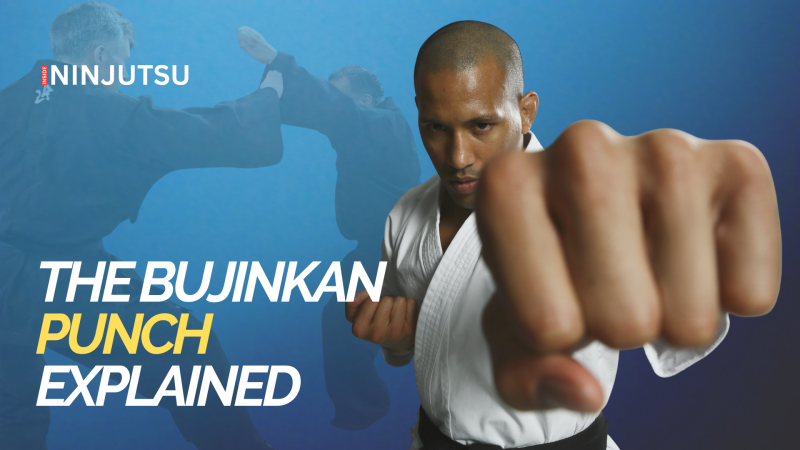
Why the Bujinkan Punch Is Different
PUBLISHED 1 AUG 2026
Don Roley explains why the striking methods of Bujinkan Budō Taijutsu are rooted in the realities of armoured combat—and why borrowing punches from other martial arts can undermine the system's principles.
Spend any time watching practitioners of Bujinkan Budō Taijutsu and one thing quickly becomes apparent: their punches look different.
To those with a background in boxing or karate, the strikes can appear unusual. They often penetrate through the target rather than snapping back, the body sinks as the strike lands, and the hand may immediately transition into a grab, lock or throw.
According to long-time Bujinkan instructor Don Roley, that difference is entirely deliberate.
In a recent episode of the Ninja/Ninjutsu Podcast, Roley explained why attempting to replace traditional Bujinkan punches with boxing techniques fundamentally changes the art and ignores the historical context in which it developed.
Built Around Samurai Armour
Roley argues that every martial art evolves to solve a particular problem.
Some systems are designed for sporting competition, others for civilian self-defence, while the classical schools preserved within the Bujinkan developed in an environment where warriors expected to encounter weapons and opponents protected by armour.
"The punch basically all came around because of armour," he explains.
Against an opponent wearing traditional samurai armour, striking with the knuckles presents obvious problems. A conventional boxing-style punch that lands on hard armour could easily injure the striker's hand while transferring little force to the opponent.
Instead, many striking methods within the Bujinkan favour open-handed techniques. Rather than attempting to punch through armour, the objective is often to disturb the opponent's balance and posture.
More Than Just a Strike
Perhaps the biggest difference lies not in the strike itself, but in what follows.
In boxing, a punch is often delivered like a whip. It accelerates into the target before retracting, allowing the fighter to reset for the next attack.
Roley suggests that the objectives in Bujinkan Budō Taijutsu are different.
Rather than striking and immediately withdrawing, the practitioner seeks to drive through the opponent's structure, remaining connected after impact. By entering deeply, the strike disrupts balance and creates an opportunity to seize, lock or throw.
"The punch goes in, the punch comes out," Roley says when describing boxing. "We don't like pulling out. Once we're in, we like to stay there."
From this perspective, the strike becomes part of a continuous sequence rather than a single isolated action.

Affecting Structure Rather Than Causing Damage
This approach reflects the wider principles found throughout Bujinkan Budō Taijutsu.
While a boxing jab or cross is designed to deliver significant impact and can be highly effective within its own system, Roley explains that the historical Bujinkan method places greater emphasis on affecting the opponent's structure.
By driving through the target instead of recoiling, the strike aims to compromise posture and make subsequent techniques easier to apply.
During his demonstration, Roley showed how even a slight disruption to an opponent's balance can dramatically reduce the effort required to execute a throw.
Rather than relying on strength alone, the strike becomes a method of creating favourable positioning.
Why Mixing Martial Arts Can Cause Problems
One of Roley's central arguments is that martial arts should be understood as complete systems rather than collections of individual techniques.
Although every style relies on the same principles of physics and body mechanics, he believes each develops its own strategy based on the circumstances for which it was created.
Attempting to replace one movement with another simply because it appears similar can introduce inconsistencies.
Roley likens the process to combining incompatible computer operating systems.
"Yes, it's all physics. Yes, it's all body mechanics," he explains. "But don't try to put together Frankenstein monsters."
In his view, borrowing boxing punches while continuing to practise Bujinkan techniques can create gaps in movement and timing because the surrounding tactics were never designed to work together.
Historical Principles in a Modern World
Although few martial artists today expect to face an opponent wearing samurai armour, Roley believes the underlying principles still have relevance.
He points out that heavy winter clothing, thick jackets or padded outerwear can absorb the force of strikes in much the same way armour once did. In those situations, a strike intended to destabilise and control an opponent may remain effective even when causing less direct impact than a conventional punch.
Whether or not every practitioner agrees with that assessment, the discussion highlights an important aspect of studying traditional martial arts: understanding why techniques developed in the first place.
The movements preserved within the Bujinkan were shaped by a very different world from modern combat sports. Appreciating that historical context helps explain why techniques that may appear unusual today often reflect practical solutions to the problems faced by Japan's warriors centuries ago.

MORE CONTENT


Add comment
Comments