


The Bujinkan Gold Medal
PUBLISHED 22 AUG 2026
Uncovering the History and Meaning of a Rare Recognition
from Masaaki Hatsumi Sōke
By Paul Johnstone
For an honour personally associated with Masaaki Hatsumi Sōke and presented to Bujinkan practitioners across several decades, remarkably little has been written about the Bujinkan Gold Medal. There is no readily accessible definitive history of the medal, no comprehensive public register identifying everyone who received it and, as far as I have been able to establish, no widely available document setting out a single universal set of criteria governing its presentation.
Much of its history therefore has to be reconstructed from individual biographies, dōjō records, photographs, certificates, contemporary accounts and the recollections of those who trained with Hatsumi Sensei. This makes the Gold Medal a fascinating but comparatively poorly documented part of modern Bujinkan history.
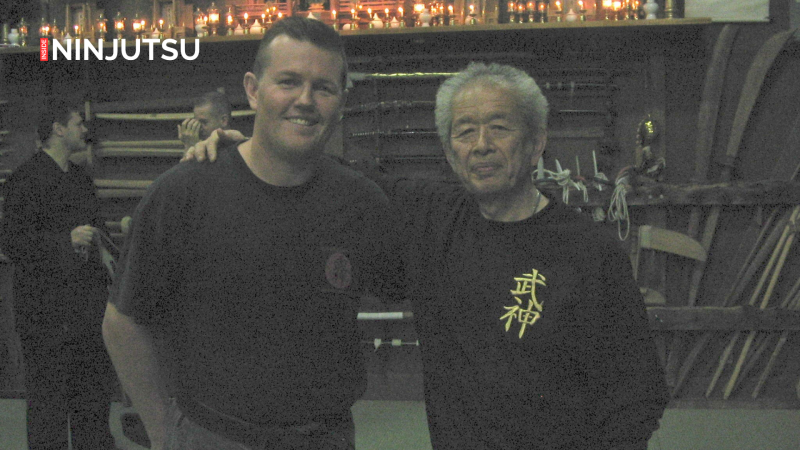
As a recipient myself, I have always regarded the medal differently from conventional martial arts rank. It is not simply another certificate or another number within the dan system. My understanding of its significance comes partly from the circumstances surrounding my own recognition and partly from examining what can be established about other presentations made by Hatsumi Sensei. When those accounts are considered together, an interesting theme emerges: the Bujinkan Gold Medal appears to have represented recognition beyond rank.
One of the most interesting discoveries when researching the medal concerns its age. A published chronology of certificates and honours associated with Hatsumi Sōke dates the Bujinkan Gold Medal to 1983. The same chronology dates the Bujinkan Silver Medal to 1987, placing the Gold Medal at a particularly important point in the international development of the Bujinkan.
During the early 1980s, Hatsumi Sensei was becoming increasingly known outside Japan and foreign students were travelling to train directly with him and senior Japanese teachers. Many returned home and established training groups and dōjō, while books, magazines, videos, seminars and Tai Kai introduced his teachings to an increasingly international audience. What had once been a comparatively small Japanese martial arts community gradually developed into a worldwide one.
The Gold Medal appeared during this formative period, but it does not appear to have been another level within the conventional Bujinkan ranking system. There was no normal "Gold Medal grade", nor have I found reliable evidence of a prescribed technical examination that automatically entitled someone to receive it. Instead, surviving accounts describe the medal as something personally presented by Hatsumi Sensei, and the recorded reasons for individual presentations were not always identical.
Some recipients were recognised for outstanding contributions to the art, while others were recognised for service, dedication or particular contributions to the Bujinkan community. British Bujinkan instructor Peter King, for example, records receiving the Gold Medal in 1987, the same year he passed the Godan test and became a Shidōshi. Roy Wilkinson has been described by his dōjō as receiving the medal personally from Hatsumi Sōke for outstanding contributions to the art.
The late British Bujinkan practitioner Norman Smithers also forms an important part of this history. Smithers is recorded as having received the Bujinkan Gold Medal from Hatsumi Sensei in September 2008 for his services to the Bujinkan. His example is significant because it provides another documented instance, from a different period of the organisation's development, in which the medal was associated specifically with service rather than simply technical rank.
Other accounts broaden the picture further. One particularly interesting case concerns the one-thousandth practitioner to pass the Bujinkan Godan test. According to the surviving account, Hatsumi Sensei presented that practitioner with a Gold Medal together with a poem reflecting upon the past, present and future of the Bujinkan. In another instance, a practitioner who created a detailed miniature representation of the old Hombu Dōjō as a gift to Hatsumi Sensei and the Bujinkan community subsequently received a Gold Medal. Documented examples also indicate that presentations continued well into the twenty-first century.
Taken together, these accounts suggest that the Gold Medal was not simply a reward for one narrowly defined technical accomplishment. Instead, a recurring theme appears to be personal recognition, service, dedication, contribution or significant achievement.
This distinction is important because martial arts naturally place considerable emphasis on rank. Rank provides structure and recognises progress, but it cannot measure everything. It cannot necessarily measure decades of contribution, loyalty, influence upon other practitioners, service to a martial arts community or the way martial principles are carried into a person's wider life.
The surviving history of the Bujinkan Gold Medal suggests that Hatsumi Sensei was, on particular occasions, recognising something extending beyond a practitioner's technical position within the ranking system.
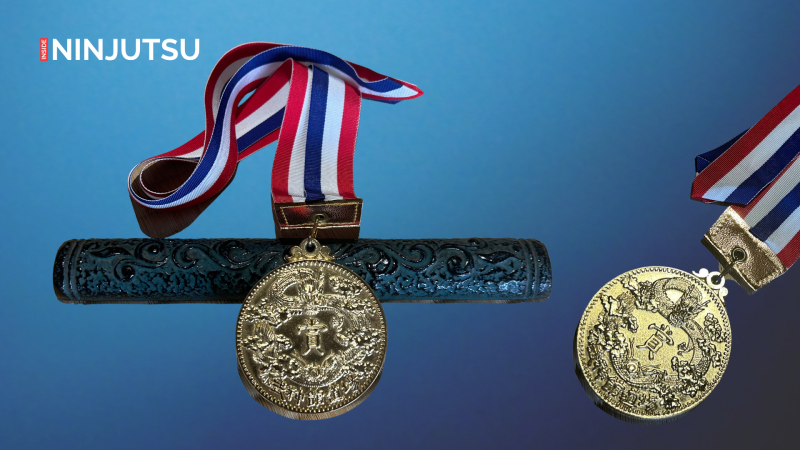
The physical medal itself provides another fascinating dimension to the story.
On the reverse of the Gold Medal is a central plaque containing Japanese characters arranged vertically in three columns. Rather than attempting to engrave the complete formal names of the schools, the design appears to employ abbreviated two-character identifiers corresponding to the nine ryū-ha traditionally associated with the Bujinkan.
These are Togakure Ryū Ninpō Taijutsu (戸隠流忍法体術), Gyokko Ryū Kosshijutsu (玉虎流骨指術), Kotō Ryū Koppōjutsu (虎倒流骨法術), Shinden Fudō Ryū Dakentaijutsu (神伝不動流打拳体術), Kukishinden Ryū Happō Bikenjutsu (九鬼神伝流八法秘剣術), Takagi Yōshin Ryū Jūtaijutsu (高木揚心流柔体術), Gikan Ryū Koppōjutsu (義鑑流骨法術), Gyokushin Ryū Ninpō (玉心流忍法) and Kumogakure Ryū Ninpō (雲隠流忍法).
The arrangement is particularly interesting because the engraver appears to have reduced each tradition to recognisable characters such as 戸隠 for Togakure, 玉虎 for Gyokko and 虎倒 for Kotō. This allowed references to all nine traditions to be incorporated into a relatively small area without attempting to reproduce their complete formal names.
Below these characters appears another inscription:
白龍翁 初見良昭
The second part, 初見良昭, is particularly significant. It is the name Masaaki Hatsumi.
The preceding characters, 白龍翁, may be read approximately as Hakuryū-ō. 白 means "white", 龍 means "dragon", while 翁 conveys the sense of a venerable or elderly man. In this context it appears to function as an artistic or honorific designation that could be rendered approximately as "Venerable White Dragon" or "Old Master White Dragon".
The reverse of the medal is therefore much more than decoration. It appears to symbolically bring together the nine martial traditions associated with the Bujinkan under Hatsumi Sensei's name. In miniature, the medal becomes a representation of the Bujinkan lineage itself.
That symbolism adds considerably to its significance. A recipient is not simply being handed a generic medal bearing the name of an organisation. The medal itself carries references to the martial traditions that Hatsumi Sensei spent decades transmitting to students throughout the world.
To appreciate that significance, it is necessary to understand the influence of Hatsumi Sensei himself. His martial development was profoundly shaped by his teacher, Toshitsugu Takamatsu, with whom he studied before inheriting a number of Japanese martial traditions subsequently associated with the Bujinkan.
Those traditions encompass an extraordinary range of martial knowledge, including unarmed combat, striking, grappling, throwing, joint manipulation, traditional weapons, strategy, movement, distancing, timing, deception and awareness, together with traditions historically associated with the samurai and shinobi.
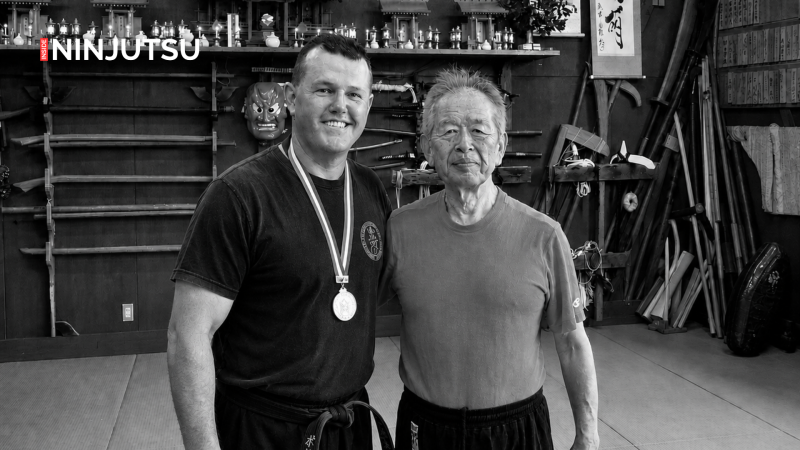
Hatsumi Sensei's contribution, however, extended beyond inheriting this knowledge. He transmitted it. Students travelled from throughout the world to study in Japan. Many returned home and established dōjō, organised seminars and introduced another generation to Bujinkan Budō. Police officers trained alongside civilians, military personnel shared the tatami with people from entirely different professions, and experienced martial artists trained beside beginners. Through Budō, people who might otherwise never have met formed friendships and training relationships spanning decades.
My own journey within the Bujinkan now extends across approximately 37 years, and receiving the Bujinkan Gold Medal from Hatsumi Sōke remains one of the most meaningful recognitions of that journey.
The recognition reflected my longstanding contribution to the Bujinkan and wider martial arts community, together with approximately 30 years of professional contribution through military, law-enforcement and intelligence-related service. It also reflected actions outside the dōjō, including an incident in Japan in which I was able to assist in saving a young person's life.
I mention that incident only briefly because it is not the subject of this article. Its relevance is that it illustrates something I have increasingly come to believe: the principles developed through Budō should ultimately extend beyond what happens on the tatami.
For me, receiving the Gold Medal therefore represented something different from receiving another martial arts grade. It represented service, contribution and responsibility.
My professional career reinforced that understanding. Approximately three decades across military, law-enforcement, intelligence, protective-security and related environments repeatedly demonstrated the importance of awareness, timing, distance, adaptability, composure and, perhaps above everything else, judgement.
I have also had the privilege of sharing knowledge with military, police and law-enforcement personnel internationally, including special-forces and specialist personnel. While traditional Budō and contemporary professional training serve different purposes, many underlying martial principles remain relevant when they are understood rather than simply copied.
The possession of martial skill carries responsibility. The greater someone's capability becomes, the greater their responsibility should become to exercise judgement and restraint.
The history of the Gold Medal also deserves further investigation because much remains unknown. We can establish that the medal appears in records from at least 1983 and identify recipients across several decades. Multiple practitioner biographies record Hatsumi Sensei personally presenting Gold Medals, and recurring descriptions associate the award with service, dedication and contribution.
Yet important questions remain. How many Gold Medals were presented? Who were the earliest recipients? Was there ever a formal written set of criteria? Did the physical design change over the decades? Were different versions produced? Did Hatsumi Sensei's reasons for presenting the medal evolve as the Bujinkan itself expanded internationally?
At present, I do not believe all of these questions can be answered definitively from publicly accessible material. That uncertainty should be acknowledged rather than replaced with speculation. Good martial arts history should distinguish between what we know, what the evidence reasonably suggests and what remains unknown.
There is still an opportunity to preserve this history. Recipients may possess original medals, certificates, photographs of presentations or notes recording the circumstances of their awards. Practitioners who witnessed presentations may remember details that have never been documented. Old newsletters and martial arts magazines may contain contemporary reports that have never been digitised.
Comparing surviving medals may itself provide valuable evidence. Differences in inscriptions, designs, presentation cases and accompanying documentation could help establish how the award developed over time. This is about more than cataloguing medals. It is about documenting the people and contributions Hatsumi Sensei chose to recognise. For me, this leads back to what may be the deeper significance of the Bujinkan Gold Medal: service rather than status.
Belts, ranks, certificates, titles and medals can all have genuine meaning, particularly when they represent decades of training and commitment. But they should never become the purpose of a lifetime in Budō. At some stage, the question must change from "What can martial arts give me?" to "What can I give back through martial arts?"
Receiving the Bujinkan Gold Medal did not complete my martial journey. Neither did receiving the title Dai Shihan (大師範). Approximately 37 years within the Bujinkan have not completed it. There is always something else to understand, another question to ask and another opportunity to discover that something we thought we understood decades ago was considerably deeper than we realised.
We are still students.
Ultimately, Hatsumi Sensei's legacy cannot be measured through the number of Gold Medals he presented, nor through certificates, dan grades or titles. His greatest legacy is found in people: those who travelled to Japan, trained, returned home, established dōjō, taught another generation, formed lifelong friendships through Budō and carried martial principles into their professions and everyday lives.
The Bujinkan Gold Medal represents one small but fascinating part of that much larger story. Its design appears to connect the recipient symbolically with the nine traditions associated with the Bujinkan, while the history of its presentation suggests recognition extending beyond conventional martial rank.
After almost four decades within the art, I increasingly believe that the true measure of a martial artist is not what they accumulate during their lifetime, but what they leave behind.
Did we preserve what our teachers gave us? Did we pass it on honestly? Did we contribute something meaningful? Did we help others? Did we remain students even after becoming teachers?
Those questions cannot be answered by looking at someone's belt or counting certificates and awards.
Perhaps that is why the Bujinkan Gold Medal continues to hold such personal significance for those fortunate enough to have received it. It represents something beyond rank. It represents recognition, contribution, service and responsibility.
In the end, the true legacy of Budō will never be measured solely by the honours we receive.
It will be measured by what we pass on to those who follow.
About the Author
Paul Johnstone, Dai Shihan (大師範), is the Founder of Bujinkan Jissen Dojos and a senior Bujinkan practitioner whose martial arts journey spans approximately 37 years, including repeated travel to Japan for training, study and research. He is a recipient of the Bujinkan Gold Medal, awarded by Masaaki Hatsumi Sōke in recognition of his contribution and service to the Bujinkan, the wider martial arts community and his professional service.
His career encompasses approximately 30 years of experience across military, federal law-enforcement, intelligence, protective-security, close-personal-protection and defensive-tactics environments. He has trained military, police and law-enforcement personnel internationally, including special-forces and specialist personnel, and has delivered training to personnel from more than 20 countries.
Johnstone also writes for media and specialist publications in Australia and internationally on martial arts, self-protection, protective security and national-security matters. Through Bujinkan Jissen Dojos, he continues to train, research and teach Bujinkan Budō while supporting the preservation of its history and traditions for future generations.

MORE CONTENT


Add comment
Comments