

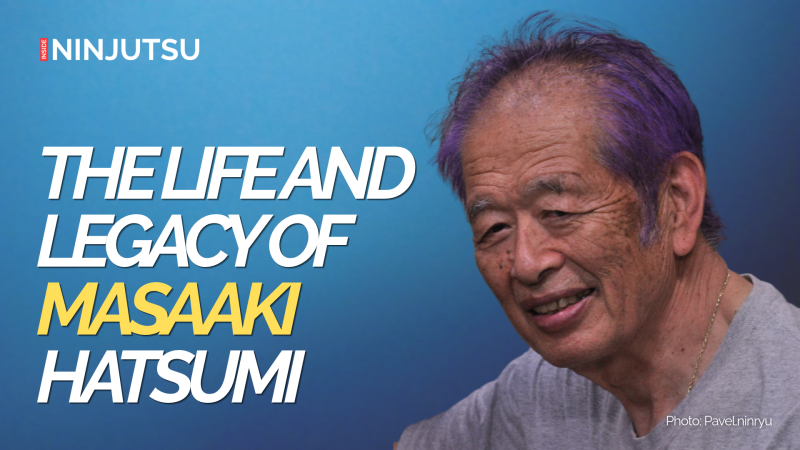
Photo credit: By Pavel.ninryu - Own work, CC BY-SA 4.0, https://commons.wikimedia.org/wiki/Special:Redirect/page/168447460
Masaaki Hatsumi: The Man Who Took Ninjutsu to the World
PUBLISHED 27 NOV 2026
From martial arts student to global Bujinkan founder
For many people outside Japan, the modern image of ninjutsu is inseparable from one man: Dr Masaaki Hatsumi.
Founder of the international martial arts organisation Bujinkan, Hatsumi spent decades teaching, writing and demonstrating the martial arts traditions he inherited from his teacher, Toshitsugu Takamatsu. There is little doubt that Hatsumi played a pivotal role in bringing ninjutsu and classical Japanese martial arts to an international audience.
Born on 2 December 1931, Hatsumi began his martial arts journey at the age of 10. As a young man, he studied a variety of disciplines, including judo, karate, aikido and kendo. He also developed a passion for football and became captain of his school team. According to accounts of his early life, Hatsumi believed that playing football helped him develop his kicking ability, something he would later incorporate into his martial arts training.
In his late teens, he also turned his attention to Western boxing, adding yet another combat sport to an already diverse martial arts background.
By the age of 20, Hatsumi had reportedly achieved the rank of fourth-degree black belt in judo. Reaching such a grade at that age was an unusual achievement and reflected the intensity with which he pursued martial arts.
Medicine and martial arts
Hatsumi studied at Meiji University in Tokyo, where he majored in theatre studies and osteopathic medicine. Following his university education, he returned to his hometown and established a bone-setting clinic.
His medical background would remain an important part of his life, but his questions about martial arts were becoming increasingly difficult to ignore.
One experience in particular is often cited as having influenced the direction of his training. After being invited to teach judo at an American military base, Hatsumi observed American servicemen learning techniques rapidly. Some of the students were considerably larger and stronger than their Japanese counterparts, and Hatsumi began questioning whether technical ability alone was enough to overcome differences in physical size and strength.
The experience prompted him to look beyond conventional modern martial arts.
Hatsumi began studying with a number of teachers of traditional Japanese martial arts, or kobudo. His search continued for several years as he attempted to understand the older combat traditions of Japan and what they might offer that modern systems did not.
Meeting Takamatsu
The turning point came in 1958, when Hatsumi met Toshitsugu Takamatsu.
Hatsumi was 27 years old. Takamatsu was already an older and highly experienced martial artist with connections to several traditional Japanese schools, including traditions associated with ninjutsu.
The meeting began a relationship that would shape the rest of Hatsumi's life.
Each weekend, Hatsumi travelled for hours by train to study with Takamatsu. The training was demanding, and Hatsumi continued learning from him for more than a decade.
Takamatsu died in 1972. Before his death, Hatsumi stated that Takamatsu had passed to him the leadership of nine traditional martial arts schools. These included traditions such as Togakure-ryū, Gyokko-ryū and Kotō-ryū, alongside six other schools.
The historical origins and transmission of these traditions remain subjects of debate among researchers. For Hatsumi, however, they became the foundation of the organisation he would establish in his teacher's honour.
The Bujinkan
Hatsumi established the Bujinkan and began teaching the nine traditions as a connected body of martial arts.
The organisation eventually developed an international following, with practitioners travelling to Japan to train with Hatsumi and Japanese instructors travelling overseas to teach seminars.
The Bujinkan headquarters was established in Noda City, Chiba Prefecture, where Hatsumi taught generations of students.
Rather than presenting ninjutsu simply as a collection of stereotypical "ninja techniques", Hatsumi's teaching incorporated striking, throwing, joint locks, grappling and weapons training. Students were exposed to a broad range of traditional Japanese martial arts methods, often through the framework of the nine ryūha.
As the Bujinkan expanded, so too did international interest in Hatsumi himself.
Taking ninjutsu worldwide
Hatsumi became one of the most recognisable figures associated with ninjutsu during the 1980s and 1990s.
He published numerous books on martial arts and ninjutsu, appeared in magazines and newspapers, produced instructional videos and travelled internationally to teach seminars. His students established Bujinkan dōjōs across Europe, North America, Australia and many other parts of the world.
In 1986, Black Belt magazine named Hatsumi its Instructor of the Year, further increasing his profile outside Japan.
His influence was not restricted to martial arts publications. Hatsumi also became a popular figure in Japanese entertainment.
He appeared in around 50 episodes of the television series Jiraiya, playing a role that helped introduce his martial arts persona to an even wider audience.
For a generation of martial artists, Hatsumi became one of the principal gateways into the world of ninjutsu.
A love of animals
Away from the dōjō, Hatsumi was also known for his affection for animals.
Over the years he kept a wide variety of animals, including dogs and cats, as well as more unusual creatures such as owls and snakes.
The image contrasts sharply with the mysterious figure often associated with ninjutsu. Behind the public persona of the grandmaster was a man with interests that extended well beyond martial arts.
A lasting legacy
Hatsumi's greatest contribution may ultimately have been his ability to take a relatively obscure collection of Japanese martial traditions and create an international community around them.
For decades, students from around the world travelled to Japan to study under him. His books, videos and seminars introduced millions of people to the word "ninjutsu", even if the popular understanding of the ninja has often been shaped by fiction as much as history.
Hatsumi's influence on the modern martial arts landscape is difficult to deny.
From a young martial artist studying judo, karate, aikido and kendo, he became a student of traditional Japanese martial arts, established the Bujinkan and eventually taught practitioners across the globe.
Today, Hatsumi is no longer active as a regular teacher. He has passed the leadership of the individual traditions and responsibilities associated with them to senior students, marking the end of an extraordinary chapter in the history of modern ninjutsu.
Whatever the future holds for the Bujinkan, its worldwide presence is inseparable from the man who built it.
Dr Masaaki Hatsumi took the traditions he received from Takamatsu and gave them an international stage. In doing so, he became one of the most influential figures in the modern history of ninjutsu.

MORE CONTENT


Add comment
Comments