

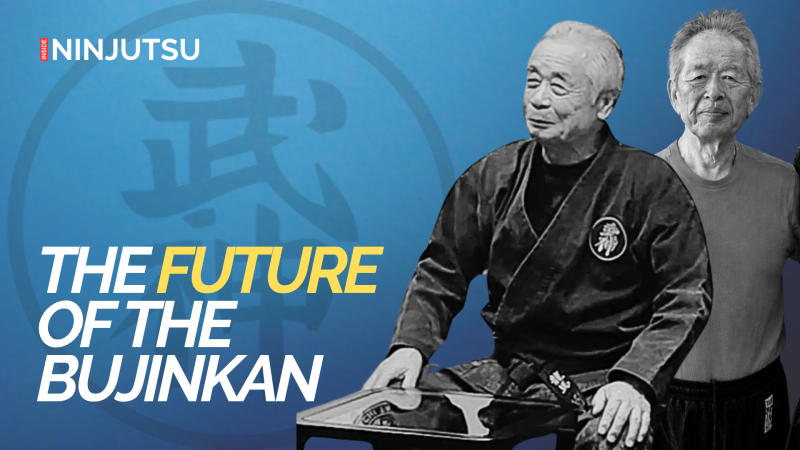
The Future of the Bujinkan
PUBLISHED 1 OCT 2026
The Bujinkan at a Crossroads
For more than four decades, the Bujinkan has grown from a relatively small martial arts organisation in Japan into a worldwide network of practitioners. Dojos now operate across the globe, connected by a shared interest in the teachings of Masaaki Hatsumi and the nine ryūha associated with the Bujinkan.
But with Hatsumi Sensei now in his nineties, and many of the teachers who formed the backbone of the organisation's development themselves advancing in years, an inevitable question is beginning to emerge: what happens next?
In a video recently posted online by Bujinkan Gokui Dojo, Dai Shihan Rob Renner offers his thoughts on the current state of the organisation and the challenges it may face in the years ahead.
Renner is particularly well placed to reflect on the subject. Having discovered Bujinkan Ninjutsu as a child in the early 1980s, he began training soon afterwards. Although he explored several other martial arts during the following two decades, his focus remained on the teachings of Hatsumi Sensei.
That commitment eventually took him around the world to attend seminars with Hatsumi and his senior instructors. More than a decade ago, Renner moved to Japan, where he has continued to train and teach. He became a familiar face at the Bujinkan Hombu Dojo, regularly training, translating and occasionally teaching. His own dojo is based at Mabashi Prince Shrine, a Shinto shrine that provides a distinctly traditional setting for his classes.
Renner has become known within the Bujinkan for attempting to simplify some of the more difficult-to-see aspects of Budo Taijutsu, while continuing to describe himself as a student and researcher.
It is his experience of the organisation's earlier years that gives particular weight to his comments about its future.
The Golden Age
Looking back, Renner describes the period when he trained in Japan under Hatsumi and his senior instructors as a "golden age" of teaching.
However, his recollection also challenges the idea that the senior instructors were necessarily a closely connected group outside their common relationship with Hatsumi.
According to Renner, instructors including Nagato, Noguchi, Oguri and Ishizuka trained within the same organisation and under the same teacher, but did not necessarily have close personal relationships with one another.
"They were together under Hatsumi Sensei," Renner explains in the video.
The distinction is important. The Bujinkan's senior teachers could operate as independent instructors while still being united through Hatsumi. Their common connection to their teacher provided an overarching structure.
That generation has now changed considerably.
Oguri Sensei and Ishizuka Sensei have both passed away, while Nagato and Noguchi remain active teachers. Renner observes that the relationship between the two surviving senior instructors has also evolved.
Rather than simply being colleagues from the same organisation, they now share something that becomes increasingly significant with time: a common history stretching back many decades.
They were there during the years when Hatsumi's teachings were being transmitted directly to his senior students. They experienced the training, the evolution of the art and the culture of the Hombu Dojo first-hand.
Renner believes that shared history has helped foster a greater sense of recognition and respect between them.
For the Bujinkan, that makes their continued teaching significant.
What Happens When They Stop?
The issue raised by Renner is not simply one of succession.
It is the possibility that an entire body of knowledge could become increasingly fragmented as the people who experienced its development first-hand eventually stop teaching.
Renner suggests that once the remaining senior instructors from that generation are no longer active, there may be fewer people capable of passing on the context surrounding what they learned.
Renner's prediction is blunt: the Bujinkan could eventually break into "little teeny tiny empires all over the place".
A Network Rather Than an Empire
Renner's own response to that possibility is to concentrate on relationships.
Rather than attempting to create a new central authority, he says he is trying to maintain connections with people who genuinely want to continue studying Hatsumi Sensei's teachings.
That means maintaining friendships, training relationships and communication between instructors and practitioners in different countries.
The result, he suggests, could be a network of people continuing to study and share what they have learned.
But Renner also sees another possible direction.
Some instructors may become increasingly focused on their own interpretation, their own organisation and their own students. As independent groups develop, individual teachers could establish what Renner describes as their own "empire".
This is not an entirely new phenomenon in martial arts. When a charismatic founder or teacher moves into the background, students inevitably develop their own interpretations. Some remain closely connected to the wider organisation, while others establish independent schools and communities.
The Bujinkan may therefore face a choice between increasing fragmentation or continued cooperation.

MORE CONTENT


Add comment
Comments