


How the Ninja Read Character from Appearance
PUBLISHED 5 JUL 2026
How medieval spies assessed personality through observation
Modern advice tells us never to judge a book by its cover. The ninja, however, would likely have disagreed. Among the many skills recorded in surviving ninja manuals is the art of assessing a person's character simply by observing their appearance. To the medieval Japanese spy, every feature of the body could provide clues about an individual's personality, status and potential.
Far from relying on intuition alone, ninja texts describe a systematic approach to reading people. A person's complexion, facial expression, gait, posture and even the timbre of their voice were all carefully analysed to build a profile of the target. These observations helped the ninja decide how best to approach, manipulate or avoid an individual.
Particular attention was paid to the face. The shape of the nose, mouth, chin and forehead were all believed to reveal important aspects of character. One example states that if there was a significant distance between the eyebrows and the tip of the nose, the individual possessed the qualities to become a "king of men" – someone destined to lead others. Likewise, a large head was considered a sign of strong leadership ability.
The body as a whole also came under scrutiny. The ninja tradition divided the human form into three principal regions. The head was known as jōtei, the trunk as chūtei and the lower limbs as katei. The proportions and balance between these areas were thought to provide further insight into a person's nature and capabilities.
These methods are preserved in the Shōninki, one of the most important surviving ninja manuals. Written in 1681 by the samurai Natori Sanjūrō Masazumi, the Shōninki forms part of the military teachings of Natori Ryū. Although the original manuscript has been lost, several later copies have survived, allowing modern researchers to study its contents.
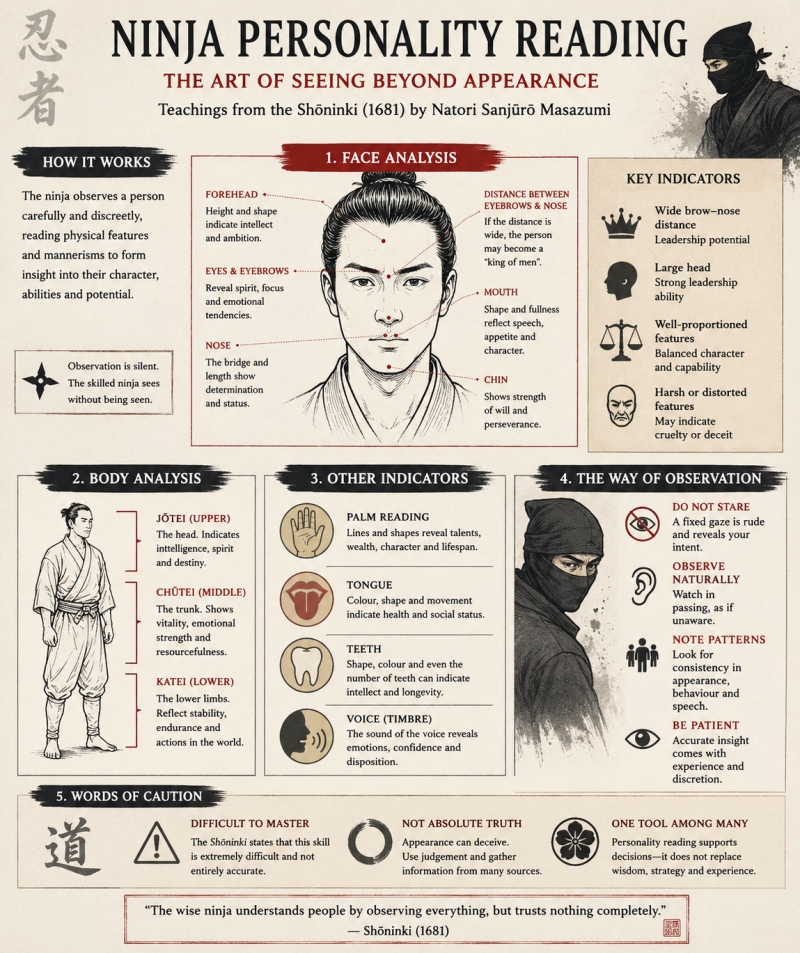
The text ventures well beyond simple observation of the face. It includes methods of palm reading, explains how the tongue may indicate a person's social standing, and claims that the shape, colour and even the number of teeth can reveal intelligence and predict longevity. Such ideas reflect the broader East Asian traditions of physiognomy that were influential during the period.
Interestingly, the Shōninki does not present these methods as infallible. From the opening of the section, the author acknowledges that judging character from appearance is an exceptionally difficult skill to master and is far from perfectly accurate. This note of caution suggests that even in the seventeenth century, practitioners recognised the limitations of physiognomy.
The manual also offers practical advice on observation itself. A ninja was expected to study people discreetly. Staring openly at a target was considered both rude and counterproductive. A prolonged fixed gaze would attract unwanted attention, undermining the very purpose of covert observation. Instead, the skilled observer gathered information naturally and without revealing their intentions.
Perhaps the most fascinating aspect of this section is the author's balanced approach. Natori clearly regarded physiognomy as worthy of inclusion in a manual of espionage, yet he simultaneously warned readers against placing complete confidence in it. Rather than presenting appearance as an absolute guide to character, he treated it as one of many tools available to an observant ninja.
Today, the claims found in the Shōninki should be understood as part of the intellectual world of seventeenth-century Japan rather than as scientifically valid methods of personality assessment. Nevertheless, they provide a remarkable insight into how the ninja sought to understand the people around them. Success in espionage often depended on making quick judgements with limited information, and the ability to read subtle physical cues was considered an essential part of that craft—even if, as the manual itself admits, those judgements were never guaranteed to be correct.
Reference
Cummins, Antony & Minami, Yoshie. True Path of the Ninja: The Definitive Translation of the Shoninki. Tuttle Publishing, 2011.

MORE CONTENT


Add comment
Comments