

How Ninja Remembered and Recorded Information
PUBLISHED 19 JUN 2026
Kioku-jutsu: The Memory Arts of Japan's Secret Agents
When people think of ninja, images of stealth, disguises and covert missions often spring to mind. Yet one of the most important skills possessed by the historical shinobi was not the sword or the shuriken—it was memory. Intelligence gathering formed the heart of many ninja activities, and without reliable methods of recording and retaining information, even the most daring mission could prove worthless.
The Ninja as Intelligence Agents
Historical sources present shinobi not primarily as assassins, but as scouts, spies and agents tasked with gathering information. During Japan's Sengoku period (1467–1615), a time of almost constant warfare between rival lords, knowledge was a weapon in itself. Knowing the strength of an enemy army, the amount of rice stores available, the condition of fortifications or the timing of an attack could provide a decisive advantage.
The value of intelligence was immense. A commander who possessed accurate information could make informed decisions, avoid ambushes and exploit weaknesses. For this reason, agents operating behind enemy lines needed to observe carefully and report their findings accurately.
Recording Information in the Field
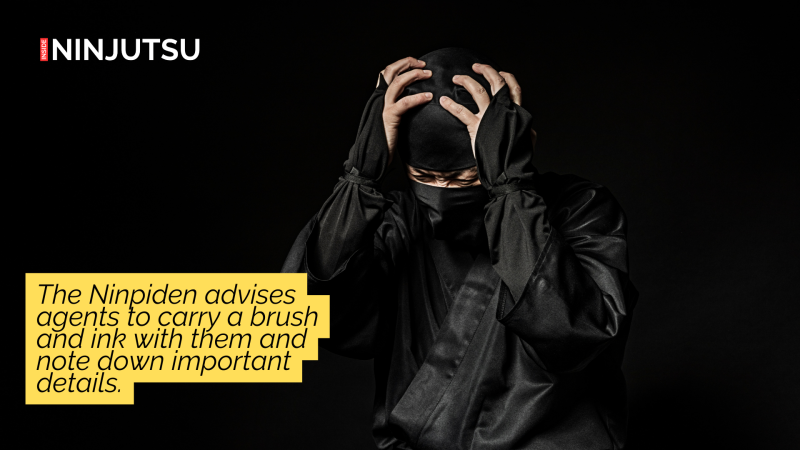
Contrary to popular assumptions, ninja were not expected to rely solely on memory. The Ninpiden, one of the major historical manuals of ninjutsu, advises an operative to carry a brush and ink while conducting intelligence missions. Important details could be noted down as they were discovered.
However, written records presented obvious dangers. Should an agent be captured carrying sensitive information, the consequences would be severe. Therefore, information often had to be transferred from paper to memory and the written notes destroyed. This necessity led to the development of various forms of kioku-jutsu—memory techniques designed to preserve information securely.
The Drawer Method
One traditional memory technique involved creating an imaginary chest of drawers within the mind. The shinobi would visualise writing down the important information and placing the note into a particular drawer. When the information was needed later, they would mentally open the drawer and read the note once again.
This method resembles what modern psychologists call the "memory palace" technique. By assigning information to specific locations within an imagined structure, recall becomes easier and more reliable.
Using the Body as a Number System
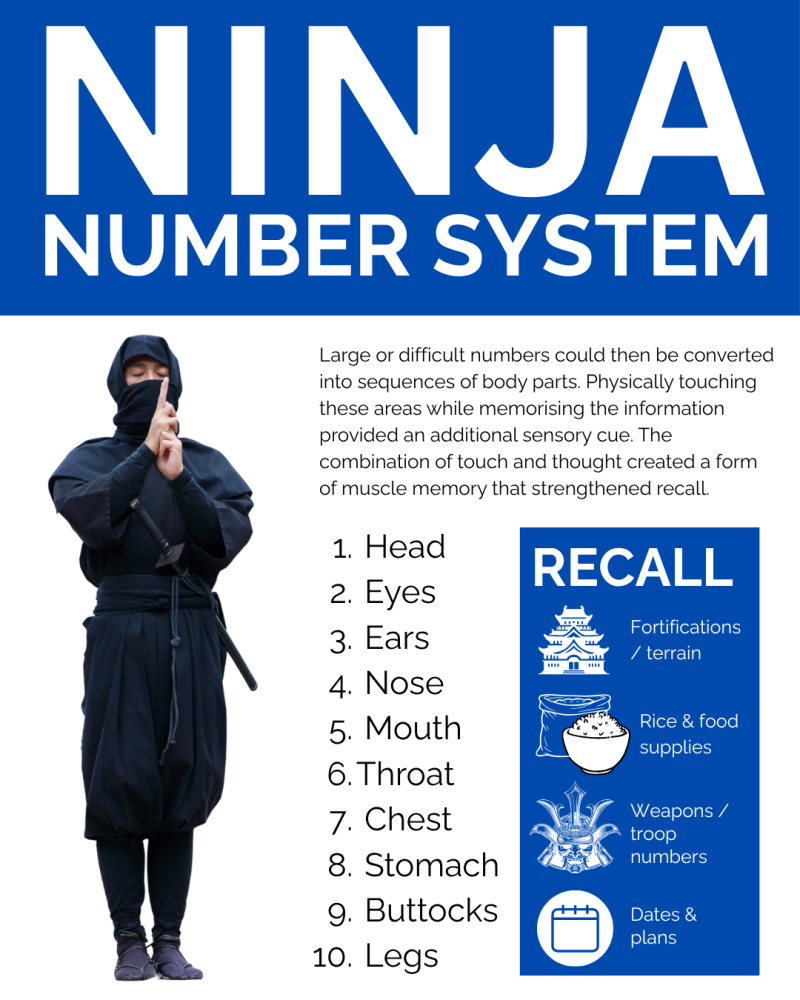
Another technique relied upon association. Different parts of the body were assigned numbers. For example:
- Head = 1
- Eyes = 2
- Nose = 3
- Chin = 4
- Throat = 5
Large or difficult numbers could then be converted into sequences of body parts. A number represented by 3-1-5-5 might become "nose, head, throat, throat". Physically touching these areas while memorising the information provided an additional sensory cue. The combination of touch and thought created a form of muscle memory that strengthened recall.
Such a system would have been particularly useful when memorising troop strengths, quantities of weapons, rice supplies or dates connected to military operations.
Remembering the Way Home
Intelligence gathering was of little use if the agent failed to return. Ancient shinobi texts therefore stress the importance of carefully observing one's route.
Travelling in medieval Japan often meant navigating unfamiliar roads at night without maps, signposts or GPS. A good memory could mean the difference between a successful mission and becoming hopelessly lost.
Shinobi would memorise prominent features in the landscape such as unusually shaped rocks, distinctive trees or other landmarks. They also created their own markers. Branches might be broken in a certain way or long grasses tied together to indicate a direction. These simple memory aids provided reassurance and guidance during the return journey.
Pain as a Memory Trigger
Among the more extreme methods recorded is the practice of associating information with pain. Minor wounds or discomfort inflicted while mentally processing information could create a powerful memory. Since painful experiences tend to leave strong impressions, the resulting scar or sensation served as a reminder of the associated data.
While fascinating from a historical perspective, such methods should be viewed as products of their time. There are far safer and more effective ways of improving memory today, and deliberately harming oneself is neither necessary nor advisable.
Ancient Lessons for Modern Life
Although centuries separate us from the world of the Sengoku-period shinobi, many of these principles remain surprisingly relevant.
Modern members of the military, emergency services and other professions requiring rapid recall may benefit from structured memory techniques. The visualisation methods described in old ninjutsu traditions closely parallel mnemonic systems still employed today.
Yet these methods need not be reserved for professionals. The same principles can help anyone remember names, appointments, passwords or even the weekly shopping list. Associating information with images, locations or physical actions can transform forgetfulness into reliable recall.
The historical ninja understood something that remains true today: information is valuable, but only if it can be remembered when it matters most. Long before smartphones and satellite navigation, the shinobi cultivated mental discipline as carefully as any martial skill. Their techniques remind us that one of the most powerful tools we possess is not carried in the hand, but housed within the mind.

MORE CONTENT


Add comment
Comments