

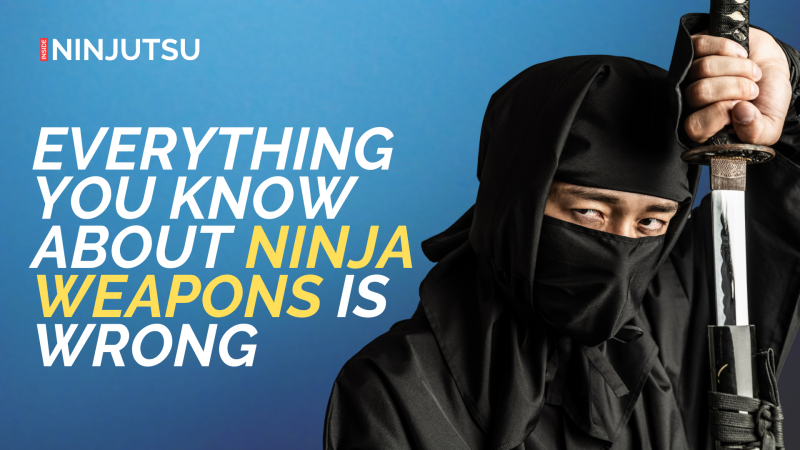
Everything You Know About Ninja Weapons Is Wrong
PUBLISHED 30 MAY 2026
Rob Tuck and the Real Ninja: Separating Shinobi History from Modern Myth
For decades, popular culture has presented the ninja as a black-clad super assassin armed with throwing stars, mystical weapons, and near-supernatural stealth abilities. But according to Japanese literary scholar Robert Tuck, much of what people believe about ninja history is actually the product of fiction rather than historical fact.
Tuck, an Associate Professor of Modern Japanese Literature at Arizona State University and author of Idly Scribbling Rhymers: Poetry, Print, and Community in 19th Century Japan, approaches the ninja not as a martial arts enthusiast or military historian, but as a literary scholar. That perspective has led him to challenge many assumptions surrounding the historical shinobi.
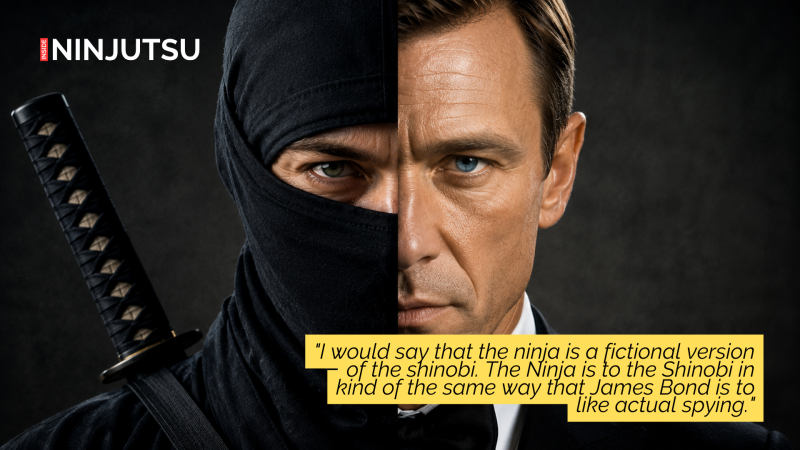
“The ninja,” Tuck explains, “is a sort of fictional version of the shinobi.”
He compares the relationship between ninja and shinobi to the relationship between James Bond and real intelligence operatives. There may be a historical kernel behind the stories, but centuries of storytelling, theatre, novels, film, manga, and television have transformed that kernel into something far removed from reality.
Fiction Built on History
Tuck does not deny the existence of covert warfare in feudal Japan. In fact, he argues the opposite.
“Something approaching the ninja existed,” he says. “Clandestine warfare was definitely a thing in Japan.”
During the Sengoku or Warring States period, Japanese warlords employed scouts, infiltrators, spies, saboteurs, and assassins. Historical documents confirm that covert operations took place and that some warriors specialized in these activities.
One example Tuck highlights is Obata Kagenori, a retainer of Tokugawa Ieyasu who infiltrated Osaka Castle during the Osaka campaigns. Pretending to support the defenders, Obata successfully passed intelligence back to the Tokugawa side while maintaining his cover even after suspicion began to fall on him.
Tuck describes the operation as “James Bond kind of stuff,” noting that Obata reportedly joked to suspicious defenders that they had been “watching too much Kabuki.”
Another documented example involves the assassination of the warlord Matsudaira Tadateru’s relative through deception rather than dramatic infiltration. The assassin gained the target’s trust by pretending to defect before ultimately murdering him while he slept.
For Tuck, these incidents are more fascinating than the exaggerated legends that later emerged around ninja culture.
“The actual history,” he says, “is fascinating enough.”
Shinobi Were Probably Not Superhuman Warriors
One of Tuck’s central arguments is that modern ninja mythology often goes far beyond what historical evidence can support.
He points out that many discussions about ninja history suffer from “massive problems of evidence, citation, and basic critical rigor.” In his view, later writers frequently repeated speculative claims until they became accepted as historical fact.
Tuck believes shinobi likely trained much like other warriors of the period rather than in some entirely separate martial system.
“The manuals don’t say too much about weapons as such,” he explains, referring to texts like the Bansenshukai, Shoninki, and Shinobi Hiden.
Although stealth and infiltration became recognized martial skills during the Edo period, there is little evidence for a distinct ninja combat curriculum during the Sengoku era. Instead, covert skills were probably passed informally between experienced warriors.
“There would have been groups of warriors who just from experience had done covert operations successfully,” Tuck says. “Whether there was a formal curriculum during the Warring States period is kind of a question mark.”
He repeatedly stresses the importance of acknowledging the limits of documentary history rather than filling gaps with speculation.
The Myth of “Ninja Weapons”
Perhaps the most striking part of Tuck’s research concerns the iconic weapons now associated with ninja.
According to Tuck, many supposedly traditional ninja weapons have no documented historical connection to shinobi at all.
Shuriken
The classic star-shaped throwing star may be the most recognisable ninja weapon in the world. Yet Tuck notes that recent Japanese scholarship has found no historical evidence linking shinobi to star-shaped shuriken.
Research from Mie University and scholar Yoshimaru Katsiya suggests the modern image of ninja using throwing stars originated largely from postwar fiction, particularly a 1957 samurai film called Yagyu Bugeicho.
By the 1960s, however, books and films were already presenting shuriken as essential ninja equipment. Over time, the fictional image became accepted as historical reality.
“That’s actually kind of shocking,” Tuck remarks.
Kunai
Modern media usually portrays the kunai as a dagger or throwing knife. Tuck argues this image also lacks historical support.
In the Bansenshukai, the kunai appears to have been more of a practical climbing or digging tool — “basically a scraper” used to hammer into walls for climbing.
The historical descriptions do not resemble the sleek weapon seen in anime and films.
“Frankly, it looks kind of like a spatula,” Tuck says.
Kusarigama
Tuck also investigated the kusarigama, the sickle-and-chain weapon commonly associated with ninja in modern martial arts culture.
His research found that the weapon certainly existed historically and appeared in martial arts traditions, but there is no documented evidence connecting it specifically to shinobi. In fact, some evidence suggests it may have been more associated with women’s martial arts practice during the Edo period.
The belief that the kusarigama was a ninja weapon appears to be a much more recent invention.
The Problem with Ninja History
Tuck believes one of the major issues in ninja studies is the tendency to overstate certainty.
“The field,” he says, “is hampered by massive problems of evidence, citation, and basic critical rigor.”
Because the surviving historical evidence is limited, many writers and researchers have filled the gaps with speculation, assumptions, or material drawn from fiction.
Tuck’s literary background gives him a unique perspective on how these myths develop. Once an idea becomes culturally established — such as ninja throwing stars or kunai daggers — it becomes incredibly difficult to dislodge, even when historians cannot find evidence supporting it.
For Tuck, understanding ninja history requires separating documented cases of covert warfare from the fictional archetype that evolved later through literature and popular entertainment.
That does not make the history less interesting.
If anything, Tuck argues, the real stories are even more compelling precisely because they are real.
The genuine history of espionage, infiltration, deception, and covert warfare during Japan’s Sengoku period does not need embellishment. The documented operations themselves already reveal a dangerous and sophisticated world operating in the shadows of samurai warfare.
And perhaps that is the most important point in Tuck’s work: the historical shinobi were not comic book superheroes — but they were real people carrying out very real clandestine missions in one of the most violent periods of Japanese history.
Readers interested in exploring more of Rob Tuck’s research and commentary on ninja history can find additional essays and analysis on his Substack, where he regularly examines the evidence behind Japan’s most enduring shinobi myths.

MORE CONTENT


Add comment
Comments