


What Did Ninja Really Wear?
PUBLISHED 8 MAY 2026
How Historical Shinobi Really Blended In
The image is instantly recognisable: a mysterious assassin dressed head to toe in black, face hidden behind a mask, moving silently through the shadows.
But according to the historical shinobi manuals of Japan, that famous “ninja uniform” is largely a modern myth.
The reality is far more practical—and far more interesting.
Ancient ninja, or shinobi, were intelligence operatives. Their mission was not to look intimidating or dramatic. Their job was to gather information, infiltrate enemy territory, and survive unnoticed. To achieve that, they dressed to blend in.
What the Shinobi Scrolls Actually Say
Historical texts such as the Gunpo Jiyoshu provide surprisingly detailed advice on clothing for covert operations.
One section advises shinobi to wear fur garments during missions. While this may sound unusual to modern readers, the logic is simple: agents often operated outdoors for long periods, hiding in forests or mountainous terrain where warmth and protection from the elements were essential.
The scrolls also recommend wearing white beneath an outer garment such as a haori jacket. In the event of combat, the outer layer could be removed quickly.
This was not about fashion—it was tactical.
White clothing could help allies identify one another during confusion or night fighting, particularly in low visibility situations where recognising friend from foe became difficult.
Blending In Was the Real Art
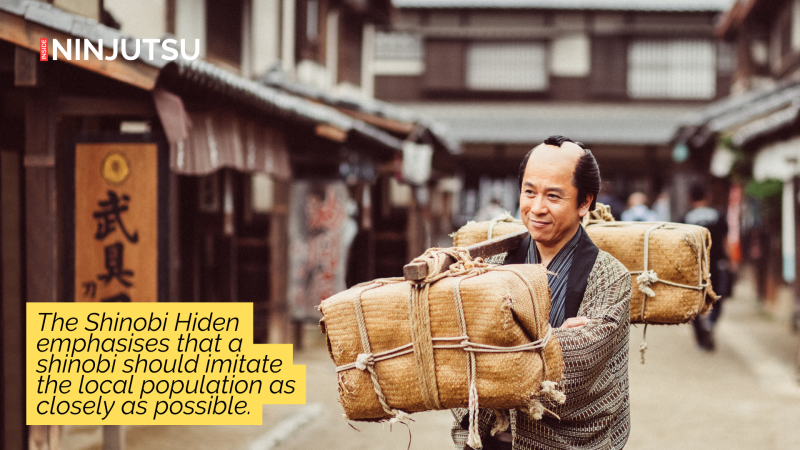
Perhaps the clearest insight into ninja clothing comes from the Shinobi Hiden, which emphasises that a shinobi should imitate the local population as closely as possible.
That meant far more than simply copying someone’s clothes.
An operative was expected to:
- Speak the local dialect
- Adopt regional customs and quirks
- Wear their hair in the correct style
- Behave naturally for the area
The disguise had to be complete.
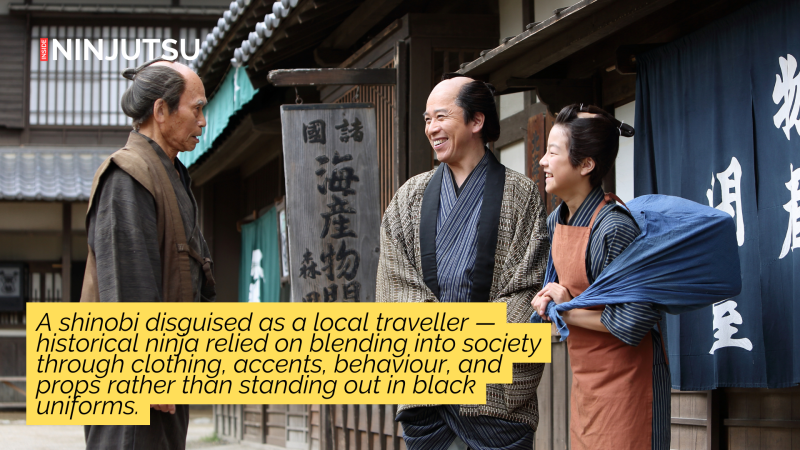
A ninja travelling through the mountains might pose as a lumberjack, complete with worn clothing and even tears in the fabric to make the appearance believable. Near the coast, the operative could disguise themselves as a fisherman or sailor, carrying props such as an oar or fishing rod to support the deception.
Other disguises included monks, merchants, shrine keepers, beggars, entertainers, farmers, or even samurai.
The key principle was simple: never stand out.
Checkpoints, Inspections, and Survival
Japan’s feudal provinces often contained checkpoints and inspections where suspicious travellers could be questioned or searched.
For a shinobi, blending into the environment was not optional—it was essential for survival.
A man dressed entirely in black with a covered face would immediately attract attention. A traveller dressed like everybody else would pass unnoticed.
This is why historical ninja manuals focus heavily on disguise, behaviour, and social performance rather than secret uniforms.
The shinobi’s greatest weapon was anonymity.
The Real Shinobi
Far from the popular image of a masked warrior lurking in the shadows, the historical ninja was a master of adaptation.
They wore ordinary clothing. They copied accents and mannerisms. They carried tools and props to support their disguises. They became part of the landscape around them.
The true art of the shinobi was not being seen in black.
It was never being noticed at all.
Reference:
The Secret Traditions of the Shinobi: Hattori Hanzo's Shinobi Hiden and other Ninja Scrolls, edited & translated by Antony Cummins & Yoshie Minami, Blue Snake Books, 2012


Add comment
Comments