

Why Resistance Matters in Bujinkan Training
PUBLISHED 10 OCT 2026
From Kata to Combat
Knowing the movements of a technique is only the beginning. Bujinkan Dai Shihan Rob Renner explains why practitioners must learn to apply their taijutsu against an opponent who actively resists.
How do you know whether a martial arts technique really works? For Bujinkan Dai Shihan Rob Renner, the answer is straightforward: you have to test it against resistance.
Speaking to Bujinkan Gokui Dojo in a discussion about training methods, Renner challenges the idea that there is a single correct way to perform a technique. Instead, he argues that practitioners must move beyond memorising movements and learn to apply them successfully against an opponent who is not simply cooperating.
“There's no correct way of doing kihon happo,” Renner explains. “There's it doesn't work. Can't do it. I can do it. I made it work.”
The kihon happo is a set of eight fundamental striking and grappling techniques within the Bujinkan system. For many students, learning these movements provides an essential foundation for developing their taijutsu. However, Renner believes that understanding the sequence of a technique is only the first stage of training.
Initially, practitioners learn the positions, movements and body relationships involved in a technique in a controlled environment. The training partner cooperates, allowing the student to understand the mechanics without unnecessary difficulty. Once those movements become familiar, however, the challenge must increase.
The next step is to introduce resistance.
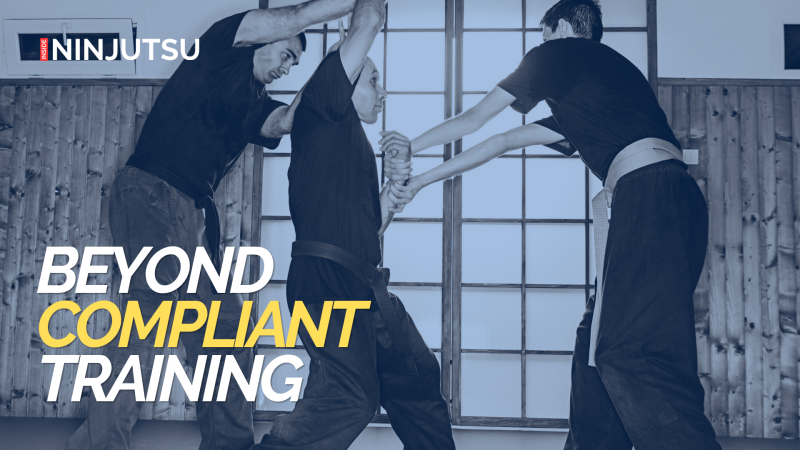
Rather than allowing the technique to happen automatically, the training partner begins to create barriers. They might stiffen their arm, resist a lock, withdraw from the movement or actively attempt to prevent the technique from succeeding. The practitioner must then adapt their movement and positioning to overcome that resistance.
For Renner, this is where meaningful learning takes place. If a technique only works when an opponent cooperates, the student has yet to demonstrate that they can apply it against someone who genuinely presents a challenge.
Crucially, adding resistance does not mean abandoning the technique when it becomes difficult. Renner argues that practitioners should not compensate by introducing additional movements simply because their original technique has failed.
He illustrates this with the example of a wrist lock. If an opponent resists the lock, the practitioner's task is to make the technique work despite that resistance. Responding by striking the opponent before attempting the lock again may achieve a result, but it does not demonstrate that the original technique worked.
The objective is not to overpower the training partner through strength. Instead, resistance encourages practitioners to refine their body mechanics, timing, movement and positioning. With experience, they should become less reliant on muscular force and more capable of using their body efficiently.
Renner also distinguishes genuine resistance from unsafe training. Partners must communicate and manage their intensity appropriately, particularly when practising joint locks. Resistance should create a meaningful challenge without needlessly risking injury.
Ultimately, the purpose is to develop taijutsu that works beyond the predictable conditions of compliant practice. By gradually increasing the difficulty and training against partners who actively resist, students can discover weaknesses in their technique and develop the ability to respond under pressure.

MORE CONTENT


Add comment
Comments