

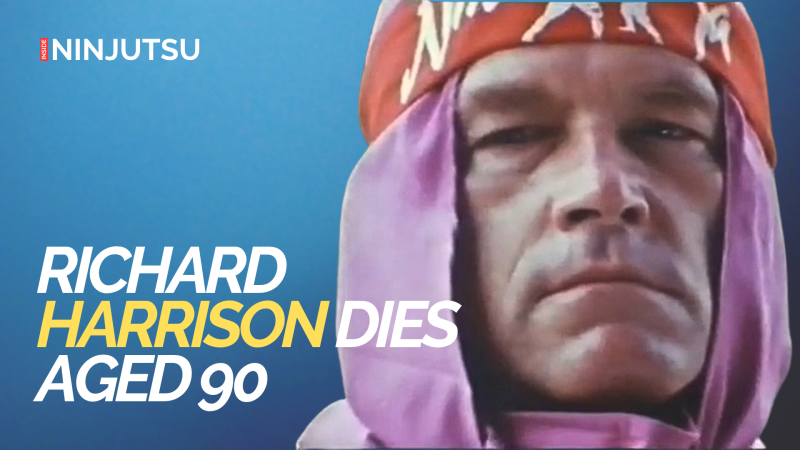
Richard Harrison: The Accidental Ninja Star
PUBLISHED 24 SEPT 2026
Ninja Terminator star dies at age 90
The actor who became one of the most recognisable faces of 1980s ninja cinema has died aged 90.
There are actors remembered for Oscar-winning performances. Others become synonymous with a particular character or franchise.
Then there is Richard Harrison.
For an entire generation of martial arts and video-store fans, Harrison was the stern-faced, muscular American who seemed to appear in an endless stream of bizarre 1980s ninja movies. Often dressed in black, surrounded by masked warriors and speaking in dubbed dialogue, he appeared to be the master of an international ninja organisation one minute and an inexplicably named martial arts expert the next.
The reality behind those films was considerably stranger.
Harrison died in Los Angeles on 18 September 2026 at the age of 90. His death was reported as being from natural causes. His passing brings to an end the life of an actor whose career stretched from Hollywood productions and Italian sword-and-sandal films to spaghetti Westerns and some of the most eccentric martial arts movies ever committed to celluloid.
But while Harrison had enjoyed a substantial career long before he ever donned ninja clothing, it was the explosion of ninja cinema in the 1980s that gave him an unusual place in cult film history.
From Hollywood to Hong Kong
Born in Salt Lake City on 26 May 1936, Harrison arrived in Hollywood as a teenager. He worked in gyms, modelled for physique magazines and studied acting before finding small roles in films including Too Much, Too Soon and South Pacific.
His career really took off overseas.
Harrison moved to Italy in the early 1960s and became a leading man in the sword-and-sandal boom, following the path established by stars such as Steve Reeves. He subsequently became a familiar face in spaghetti Westerns and European exploitation cinema. He also worked in Hong Kong for Shaw Brothers during the 1970s, appearing in films including Marco Polo and The Boxer Rebellion.
By the 1980s, however, the European film industry that had provided Harrison with so much work was in decline. Harrison later recalled that there was simply very little work available in Italy, prompting him to look elsewhere.
That eventually brought him back to Hong Kong.
And into the world of the ninja.
The Ninja Boom
The early 1980s saw ninjas explode in popularity around the world.
Films such as Enter the Ninja helped convince producers that audiences wanted martial arts action, masked assassins, throwing stars and black-clad warriors. Hong Kong producers were quick to exploit the trend.
One of the companies at the centre of this movement was IFD, headed by Joseph Lai, with filmmaker Godfrey Ho becoming its most notorious director.
Ho developed a remarkably economical approach to filmmaking. Rather than necessarily making a complete feature from scratch, he could shoot new ninja footage and combine it with material from existing Asian films, creating a new movie through editing, dubbing and recontextualisation. The result could feature completely different casts, storylines and visual styles stitched together into a single film.
And Harrison became one of the faces of the operation.
His appearance gave the films something they desperately wanted: a recognisable Western star.
In Ninja Terminator, Harrison played Ninja Master Harry MacQueen. In other films he became characters such as Ninja Master Gordon Anderson. His imposing physique, unmistakable face and previous action-movie career made him a natural fit for the role of the mysterious Western ninja master.
The films were made quickly and cheaply, but the ninja imagery was everywhere.
Masked warriors fought with swords and shuriken. Smoke bombs appeared. Martial artists battled across warehouses, streets and forests. Characters discussed mysterious ninja organisations with complete seriousness.
And then Harrison would appear.
The Garfield Phone
Perhaps nothing captures the strange charm of these films better than Ninja Terminator.
Harrison's Ninja Master Harry spends part of the film communicating through an ordinary Garfield telephone.
It is an image that has become legendary among fans of 1980s martial arts cinema: the supposedly deadly master of a secret ninja organisation conducting business through a brightly coloured cartoon cat phone.
It was completely ridiculous.
It was also unforgettable.
The films' strange mixture of serious martial arts action, awkward English dialogue, dubbing, recycled footage and bizarre props helped turn them into cult favourites decades after their original release. Ninja Terminator, for example, incorporated substantial footage from the Korean film The Uninvited Guest of the Star Ferry, with Harrison's newly filmed material woven into the existing movie.
For many young martial arts fans discovering these films on VHS, however, none of that mattered.
The box said Ninja.
Richard Harrison was on the cover.
That was enough.
An Unwilling Ninja Star
There was, however, a less amusing side to Harrison's association with the films.
Harrison later spoke openly about his frustration with the way his footage had been used. In an interview, he described the experience as painful and said he had originally believed he was making a much smaller number of films.
Godfrey Ho himself subsequently acknowledged that Harrison's footage had been reused to create additional movies. Ho said Harrison had been contracted for perhaps two or three films, while producers subsequently used editing to turn the material into considerably more releases. Ho recalled Harrison confronting him over the situation.
That helps explain one of the great oddities of Harrison's filmography.
He appears to be everywhere.
Different costumes. Different character names. Different plots. Different films.
Yet sometimes the footage is clearly from the same shoot.
Sometimes Harrison has a moustache.
Sometimes he doesn't.
Sometimes he appears to be involved in a ninja adventure. At other times, his scenes seem to belong to an entirely different film.
The cut-and-paste method was not merely a strange stylistic choice. It was an economic filmmaking system that allowed producers to create numerous releases from a relatively small amount of newly shot material.
Harrison eventually became disillusioned with the experience and returned to the United States.
A Cult Legacy
It would be easy to dismiss Harrison's ninja films as little more than cinematic curiosities.
And, by conventional filmmaking standards, they certainly occupy an unusual place in cinema history.
But their influence on the perception of the ninja in the West is worth considering.
The 1980s ninja boom helped establish a particular visual language: the black uniform, the masked warrior, the sword, the shuriken, smoke bombs, secret organisations and mysterious masters.
Much of this imagery owed more to popular cinema than historical Japanese sources.
Yet these films became part of the cultural environment in which a generation encountered the idea of the ninja.
For martial artists, film fans and collectors of obscure VHS releases, Harrison's movies became something else entirely: cult cinema.
Titles such as Ninja Terminator, Ninja the Protector, Ninja Thunderbolt, Ninja Hunt, Ninja Dragon, Ninja: Silent Assassin, Cobra vs. Ninja and Diamond Ninja Force turned up again and again in Harrison's extraordinary filmography.
His face became almost inseparable from the strange world of Hong Kong's 1980s ninjasploitation.
Remembering Richard Harrison
There is an irony to Harrison's legacy.
He had already lived several cinematic lives before he became a ninja.
He was a Hollywood actor, a sword-and-sandal star, a spaghetti Western leading man and a veteran of international exploitation cinema. He worked with major figures and accumulated more than 100 film credits during a career that took him around the world.
But for a generation of martial arts fans, Richard Harrison will always be Ninja Master Harry.
The stern expression.
The American accent.
The black-clad warriors.
The inexplicable plots.
The throwing stars.
And, of course, that Garfield telephone.
His ninja films may never have been intended to become classics. Harrison himself certainly did not appear to regard the experience with the same affection as the audiences who eventually discovered the movies.
But cinema history has a habit of preserving the things nobody expected to last.
Richard Harrison's accidental ninja career is one of them.
He may not have set out to become one of the faces of 1980s ninja cinema.
But decades later, his image remains instantly recognisable to anyone who grew up searching the shelves of a video shop for one more film about the mysterious warriors of the shadows.
Richard Harrison, 1936–2026.
The accidental Ninja Master.

MORE CONTENT


Add comment
Comments