

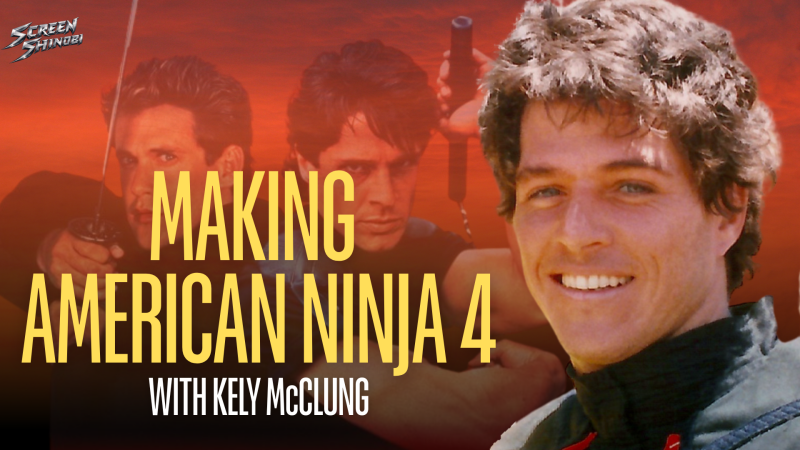
Making American Ninja 4
PUBLISHED 27 FEB 2026
When American Ninja 4: The Annihilation exploded onto screens in 1990, it delivered everything fans expected from the franchise—rogue military plots, masked ninjas, exotic locations and an explosive finale. Directed by Cedric Sundstrom and starring Michael Dudikoff and David Bradley, the fourth instalment marked Dudikoff’s final appearance in the series.
The plot revolves around a terrorist conspiracy to blow up New York City unless a $50 million ransom is paid. Agents Sean Davidson, Carl Brackston and Joe Armstrong must unite to stop the threat. The action unfolds against the dramatic landscapes of southern Africa, with ninjas training in the countryside and geopolitical tension simmering in the background.
But behind the on-screen chaos lies a story far more compelling—told by the man behind the mask: Kely McClung, the martial artist who brought the villainous “Super Ninja” to life.
From Stick Fighting Champion to Silver Screen Villain
Before stepping onto a film set, Kely McClung had already forged a formidable reputation in the martial arts world. Having trained in dozens of fighting systems, he broke into the film industry after winning the brutal International Full Contact Stick Fighting Championships.
Yet his entry into Hollywood came with high stakes.
At the time, producers were reportedly searching for the “next” Jean-Claude Van Damme. Van Damme’s early films had been so successful that he was renegotiating contracts—and studios, according to McClung, were quietly looking for a replacement.
“I was brought in to be that next guy,” McClung recalls.
What followed was a harsh introduction to Hollywood politics: a meeting in a Hollywood penthouse suite that quickly unravelled into hours of personal criticism from a key decision-maker. The opportunity collapsed as quickly as it appeared.
But fate intervened.
Legendary martial artist and fight coordinator Mike Stone invited McClung to join him in South Africa for American Ninja 4. “Let me manage you,” Stone said. “I’m going to Africa. Come with me.”
And just like that, the next chapter began.
South Africa, Apartheid’s End, and a Crash Course in Cinema
Filming took place during a pivotal moment in South African history—the final years of apartheid. McClung immersed himself in the culture whenever production paused, visiting villages, meeting locals from different communities and absorbing the atmosphere of a country in transition.
Professionally, delays in production proved a blessing. They allowed Stone to school him in the nuances of screen combat.
“Movie fighting is not fighting,” McClung says.
Already camera-aware from filming instructional material for his own students, McClung deepened his understanding of angles, distance and illusion. The difference between landing a strike and selling one became his new obsession.
And he didn’t just play one role.
Eighteen Characters, One Mask
Originally, Mike Stone was set to play Super Ninja. When circumstances changed, McClung was offered the role. As a masked villain, he gained something rare in cinema: invisibility.
“I played like eighteen different people in that movie,” he laughs.
McClung doubled extensively for David Bradley and, at times, for Michael Dudikoff. Bradley’s explosive kicking ability was elite—“He could kick better than me in terms of form”—but McClung’s weapons expertise often put him in frame. Dudikoff, meanwhile, was more actor than martial technician, but, as McClung notes, “Michael would let you make him look good.”
In one remarkable sequence, McClung effectively fights himself—doubling both masked combatants in the same scene. “I spin, I take the punch, I kick, I take the kick.”
Wigs were occasionally deployed to disguise the switches. They rarely fit. Sharp-eyed viewers can spot moments where Dudikoff spins into a kick with dark hair—only to land with blonde hair again.
Baptism by Bruises
Action cinema may look glamorous, but McClung describes it as relentless.
On his first day, filming an opening sequence with a shotgun, he carefully placed the prop on the ground between takes—only to be told to throw it down harder. Producers Danny and Avi watched in disbelief at his cautiousness.
In the climactic melee, a spiked leather jacket sliced open his bicep during a chokehold. A river sequence required submerged timing under a tight ninja mask; on the final take, he resurfaced nearly half a mile downstream—unnoticed.
And then there was his first nude scene. Day three. Tied up. Surrounded by 200 crew members. “Dreaming of being an actor,” he laughs, “and here I am in a loincloth in a ninja movie.”
Tension Behind the Camera
Production wasn’t without friction. Dudikoff was brought in mid-shoot with a lucrative contract to bolster the franchise. Bradley, fresh from American Ninja 3, found himself in an awkward position. Rivalries were common in that era of action cinema—long before ensemble nostalgia projects made cooperation fashionable.
McClung, a newcomer with perceived star potential, was caught somewhere in between.
He later learned he’d been viewed as a possible future leading man—marketed, in one producer’s mind, as a “martial arts Mel Gibson,” just as Dudikoff had been pitched as a muscular James Dean.
At the time, however, McClung was simply absorbing everything. Visiting the editing room and studying how fight scenes were cut together.
In one unforgettable moment, he discovered the hard way that actors don’t need to supply their own sound effects. Watching early footage in the editing room, he cringed as he saw himself mouthing “Pow!” during strikes. “We’ll add the sound later,” the editors assured him.
The Kick That Saved the Production
The film’s climax features the showdown between Super Ninja and Dudikoff’s Joe Armstrong. McClung choreographed many of the movements himself, pushing speed and intensity.
In one take, adrenaline surged. McClung launched a spinning kick. Dudikoff was meant to duck.
“He didn’t even know I’d moved yet,” McClung recalls.
Mid-flight, McClung adjusted—lifting his kick higher at the last split second. Instead of smashing into Dudikoff’s face, his foot struck the camera, sending it flying.
Producers later thanked him. Cameras could be replaced. A hospitalised star would have shut down the production entirely.
“That would have cost a lot of money,” he smiles.
A Villain’s Regret
One lingering disappointment remains. In an earlier draft of the story, Super Ninja was meant to defeat Bradley’s character — justifying Dudikoff’s dramatic arrival. The scene was altered.
But as a young actor, he didn’t push for changes. “I was just happy to be there", McClung reflects.
And perhaps that gratitude is what defines his memories most. He trained, learned, bled, and laughed. He experienced the full machinery of moviemaking from inside the mask.
Watching the film today, he still marvels at the athleticism of his younger self—particularly the final explosive sequence, where a simple kick reaction sends him soaring improbably high before a dummy takes his place in the blast.
“I can’t do that now,” he laughs. “Maybe a couple of inches—but not five feet in the air.”
Legacy of a Masked Warrior
American Ninja 4 may be remembered for its pulp-action spectacle, but for Kely McClung it represents something deeper: a brutal, exhilarating apprenticeship in cinema.
Sometimes, the most dangerous ninja on screen is also the one making sure everyone else gets home safely.


Add comment
Comments