

Why Details Matter
PUBLISHED 7 NOV 2026
The Simple Question That Changed William Ustav’s Bujinkan Training
A simple question from renowned martial artist and scholar Dr Kacem Zoughari gave Bujinkan practitioner William Ustav an unexpected lesson in the importance of detail.
Ustav was a green belt and still relatively new to the Bujinkan when he attended his first seminar with Zoughari, the author of Ninja: Ancient Shadow Warriors of Japan. During the Friday class, the group were practising ura gyaku, a reverse wrist-locking technique.
The technique begins with an attacker grabbing the defender by the collar. The defender moves backwards into Ichimonji no Kamae, adopting a side-on position with the weight on the rear leg. The legs then switch as the defender takes control of the attacker's grabbing hand before applying the reverse wrist lock.
Zoughari was working his way around the class, personally correcting the students as they practised. For Ustav, this was notable in itself. He recalls that he had not often seen Bujinkan instructors move around a class correcting each individual student and physically working through the movements with them.
When Zoughari reached Ustav, he pointed out that his weight needed to be on his back leg. Confident that he was already doing exactly that, the young green belt replied: "My weight is on the back leg."
Zoughari disagreed.
Rather than simply explain the point again, he gave Ustav a practical test. He asked him to lift his leg into Hicho no Kamae without shifting his body or making any unnecessary movement.
Ustav tried, but immediately discovered a problem. He could not raise his leg without first shifting his weight or rising on his supporting leg.
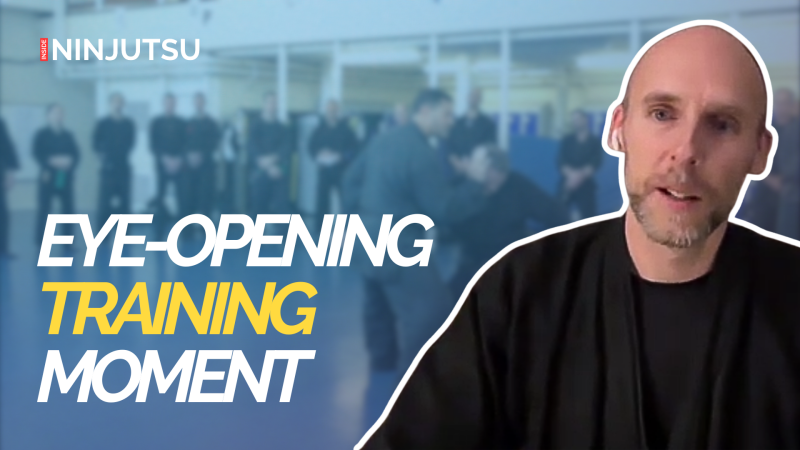
The result was an eye-opening moment.
"Ah, okay," Ustav recalls thinking.
The exercise had demonstrated something that a verbal explanation could not. Although Ustav believed his weight was correctly positioned on his back leg, his inability to lift the other leg without making an additional movement showed that his balance and weight distribution were not quite what he had assumed.
For Ustav, the experience changed the way he approached his training. It was no longer enough to simply recognise a position or believe that he was performing a technique correctly. He had to pay attention to the small details of how his body was actually moving.
"That really opened everything up to me at that moment," Ustav recalls. "So that really put me into the mode of really paying attention to details."
It was a lesson that came from a seemingly minor correction, but one that demonstrated the difference between looking as though a technique is being performed correctly and having the body mechanics to prove it.
For a martial artist at the beginning of their journey, it was also a useful reminder that confidence can sometimes hide the things that still need to be learned. In this case, a simple test exposed a flaw that Ustav had been unaware of.
Years later, it was not the wrist lock itself that remained most memorable. Instead, it was the moment when a straightforward question forced him to reconsider something he had been certain he already understood.
The lesson was simple: in martial arts, the smallest details can reveal the biggest differences.

MORE CONTENT


Add comment
Comments