

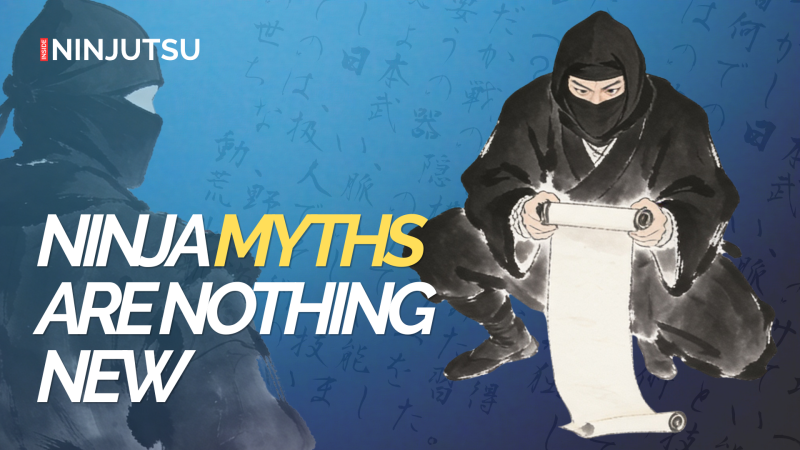
The Myths of Ninjutsu Are Nothing New
PUBLISHED 26 NOV 2026
A warning from more than a century ago
The idea that misinformation about the ninja is a modern problem might come as a surprise. But more than a century ago, one of Japan's prominent researchers of ninjutsu was already complaining about the myths and misconceptions surrounding the subject.
In Ninjutsu no Gokui (The Essence of Ninjutsu), journalist and researcher Gingetsu Itoh took aim at what he saw as a lack of serious investigation into the historical art of the shinobi. At one point, Itoh writes that “the eyes of the average citizen are covered against the truth”, before expressing his frustration at the misinformation being presented as fact.
He goes further, arguing that it was “absolutely outrageous” that, in the face of the mistruths being told about ninjutsu, there was no proper research being carried out to honour the current generation.
For Itoh, this was not simply an academic issue. He believed the historical record was being obscured by misconceptions at a time when researchers should have been examining the surviving evidence.
Searching the records
Gingetsu Itoh was a journalist with the Yorozu Morning Paper and wrote a series of articles about ninjutsu for the Tokyo Asahi newspaper. Those articles were subsequently brought together as a single volume.
Itoh established himself as a leading researcher in the field, examining documents and records relating to shinobi in an attempt to separate historical evidence from popular assumptions.
One particularly interesting aspect of his work is his treatment of the relationship between the shinobi and criminal activity. Some of the duties attributed to ninja could, on the surface, resemble the activities of a thief. Infiltrating buildings, moving covertly and gathering information might look suspiciously similar when stripped of their historical context.
But Itoh argues that the two should not simply be regarded as the same thing.
For him, the purpose of ninjutsu was fundamentally connected with infiltration and observation. The objective was to obtain information and survive situations in which the odds were heavily against the individual. Itoh ultimately describes ninjutsu as a method of emerging victorious from a grim or difficult situation.
That interpretation is considerably more nuanced than the image of the ninja as simply a medieval burglar dressed in black.

The black-clad ninja
There is, however, an amusing contradiction in Itoh's work.
Despite his criticism of misinformation and his insistence on proper research, Itoh himself sometimes embraced imagery that would become synonymous with the modern conception of the ninja.
In Gendaijin ni Ninjutsu, illustrations depict shinobi wearing the now-familiar hooded black outfit. One illustration shows a shinobi demonstrating a cross-step style of walking. Another depicts a figure using a sword as a step to scramble up a wall, while another shows a black-clad figure leaping from a castle wall.
In other words, even a researcher who was warning readers about misconceptions surrounding ninjutsu could contribute to some of the imagery that would later become embedded in the popular understanding of the ninja.
This doesn't necessarily invalidate Itoh's research. Rather, it demonstrates just how difficult it has always been to separate historical shinobi practices from the imagery and assumptions that grew around them.
The problem continues
More than a century later, the argument remains surprisingly familiar.
Authors such as Stephen Turnbull and Antony Cummins have attempted to challenge and correct many of the myths surrounding the ninja. Turnbull has even revisited and corrected aspects of his own earlier work, notably with his 2017 book Ninja: Unmasking the Truth.
Yet the myths remain remarkably persistent.
Part of the problem is that fact and fiction are often blended together without any clear distinction. A genuine historical technique might appear alongside a theatrical invention, while an illustration from a much later period can be mistaken for evidence of what medieval shinobi actually looked like.
Well-meaning writers, filmmakers, martial artists and online content creators can then repeat those claims, often without realising that the original source was itself drawing upon questionable information.
Perhaps the most interesting lesson from Gingetsu Itoh is therefore not simply what he believed about ninjutsu, but the fact that researchers were already arguing about misinformation more than a century ago.
The search for the historical ninja has never been straightforward. And if Itoh's warnings are anything to go by, the challenge of separating the shinobi of history from the ninja of popular imagination is almost as old as the modern image of the ninja itself.
Source: Eric Shahan's English translations of Gingetsu Itoh's Gendaijin no Ninjutsu and Ninjutsu no Gokui.

MORE CONTENT


Add comment
Comments