

Questioning the Lineage
PUBLISHED 28 APR 2026
Antony Cummins and the Bujinkan Debate
Author and researcher Antony Cummins has reignited a long-standing debate within the ninjutsu community: are the nine schools of the Bujinkan truly ancient traditions, or are they a more modern construction?
Cummins—known for works such as Ninja Skills and The Ultimate Art of War, and for his involvement in translating historical samurai texts—has openly questioned the legitimacy of the lineages associated with the Bujinkan system. His claims focus particularly on the figure of Toshitsugu Takamatsu, the teacher of Bujinkan founder Masaaki Hatsumi.
The Historical Framework: Takamatsu and Hatsumi
To understand the controversy, it’s important to first outline the accepted narrative.
Takamatsu, sometimes referred to as the “Mongolian Tiger,” was a Japanese martial artist born in 1889. According to accounts passed down through his student Hatsumi, Takamatsu trained in multiple martial traditions and even travelled through China, engaging in real combat encounters. He is said to have inherited several martial lineages, including ninjutsu schools, from his own teacher, Toda Shinryūken.
These teachings were later passed to Masaaki Hatsumi, who went on to establish the Bujinkan. Under the banner of Bujinkan Budō Taijutsu, Hatsumi brought together nine distinct ryūha under one umbrella organisation.
For practitioners, these schools represent a living connection to Japan’s martial past—often said to stretch back hundreds of years to the era of the ninja.
Cummins’ Central Claim
Cummins challenges this narrative at its core. He argues that Takamatsu may not have inherited ancient systems at all, but instead constructed or significantly reshaped them in the modern era.
“I’m not saying he made everything up. But… you totally can,” Cummins states in a recent video, pushing back against the idea that the sheer volume of material proves authenticity.
He specifically points to schools such as Togakure Ryū, suggesting they may be nothing more than a figment of his imagination, or at least heavily reconstructed rather than historically continuous.
The Tolkien Comparison
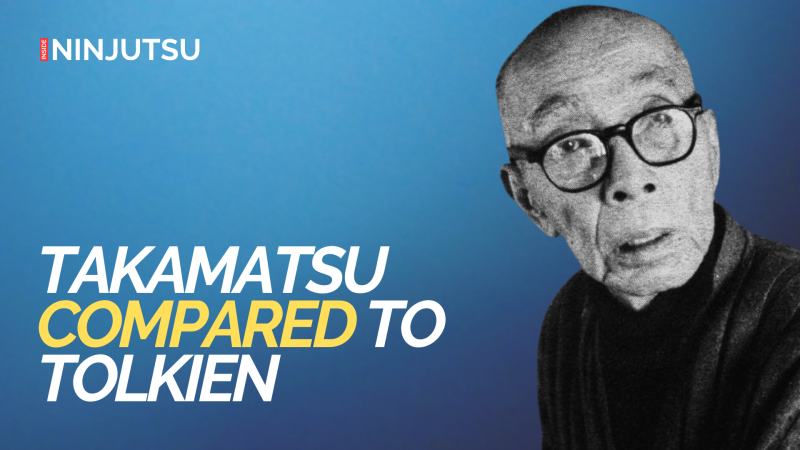
One of Cummins’ most striking arguments is his comparison of Takamatsu to fantasy authors. Referencing J. R. R. Tolkien, he explains:
“Tolkien wrote millions of words… and he literally made it up out of old sources… Takamatsu and Tolkien are very similar.”
The implication is clear: the creation of a detailed, internally consistent system does not necessarily make it historically real. Cummins extends this comparison to other writers such as H. P. Lovecraft, noting that entire mythologies can be constructed by a single individual.
For Cummins, the existence of complex kata, genealogies, and techniques within the Bujinkan does not prove antiquity—it may instead demonstrate the depth of a modern synthesis.
Constructed Lineage?
A key part of Cummins’ critique lies in the genealogies of the schools themselves. He suggests that creating a lineage—complete with historical figures and timelines—is not particularly difficult:
“He made a chronology… and he made a family lineage. Not hard to do… you could probably do it in a week or so.”
He also argues that inconsistencies within the traditions may point to later construction rather than organic historical development:
“You’ve got things that don’t quite add up… things that don’t match… you can tell it’s a construction because of that reason.”
This aligns with earlier academic skepticism surrounding some classical martial arts lineages, where documentation can be sparse or contradictory.
Contextual Evidence and Ongoing Debate
It’s worth noting that questions around Takamatsu’s claims are not new. Even historical sources such as the Bugei Ryūha Daijiten have suggested that certain genealogies may have been “arranged” or embellished.
At the same time, the Bujinkan community maintains that its teachings are rooted in authentic transmission. Hatsumi himself has passed on leadership of the nine schools to various successors, ensuring continuity into a third generation.
Even critics acknowledge this evolving legitimacy. As some observers note, regardless of their origins, the Bujinkan traditions now represent a lineage in their own right—one that “definitely goes back three generations.”
A Divisive Question
Cummins ultimately frames the issue as one of historical scrutiny rather than outright dismissal. His goal, he suggests, is to challenge assumptions:
“The idea that it’s got to be real because Takamatsu could not have made it all up—no, not at all.”
For practitioners, the debate raises deeper questions about what defines authenticity in martial arts. Is it unbroken historical lineage, or the effectiveness and continuity of practice?
As the discussion continues, one thing remains certain: the legacy of Takamatsu, Hatsumi, and the Bujinkan will remain a focal point for both admiration and critical examination within the ninjutsu world.


Add comment
Comments