


Master the Art: Unlocking the Secrets of Ninja Training
UPDATED 1 SEPT 2026
Forget the fantasy. Step beyond the dojo. The real shinobi path begins when you start studying the world around you.
For many people, ninja training begins and ends in the dojo. They attend class once or twice a week, practise punches, throws and weapon techniques, perhaps read a book on ninjutsu, and then return home feeling that they are following in the footsteps of Japan's legendary shadow warriors. Martial arts are undoubtedly an important part of the picture, but according to author and researcher Antony Cummins and samurai and shinobi traditions researcher Steven Nojiri, they are only the beginning.
The historical shinobi was not simply a martial artist dressed in black. The shinobi arts existed within a wider world of warfare, intelligence gathering, psychology, geography, language, disguise, religion and practical knowledge. To seriously explore that world today requires more than collecting techniques. It demands curiosity, research and a willingness to step outside the familiar surroundings of the dojo.

LEAVE THE FANTASY BEHIND
The first step is accepting an uncomfortable truth: nobody can literally become a historical shinobi today. The samurai class and the feudal military world in which shinobi operated disappeared long ago. That does not mean that the shinobi arts cannot be studied, reconstructed or explored, but modern practitioners need to be honest about what they are doing.
Are you studying Japanese history? Reconstructing techniques described in historical documents? Exploring a modern martial tradition connected with ninjutsu? Or simply trying to understand the skills and mindset associated with historical shinobi? All are valid pursuits, but Cummins and Nojiri argue that the serious student must follow the evidence rather than allowing fantasy to dictate their conclusions.
Historical sources should lead the way. If new evidence challenges something you previously believed about ninja history, be prepared to change your mind. The ability to question assumptions and accept where the evidence leads is arguably one of the most important skills any serious student can develop.
MARTIAL ARTS ARE THE FOUNDATION—NOT THE WHOLE HOUSE
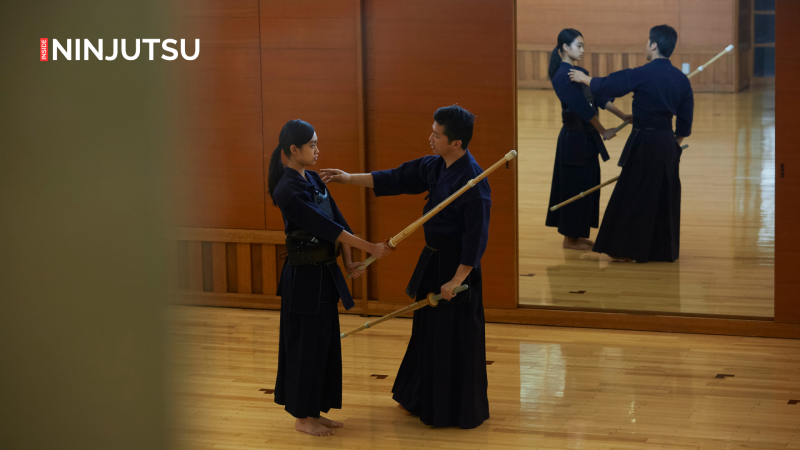
A shinobi operated in a warrior environment, so a working knowledge of combat and weapons was naturally important. However, being a skilled fighter did not automatically make someone a shinobi. The modern student should therefore think beyond a single martial art and develop a broad physical foundation that might include unarmed combat, grappling, traditional weapons, projectile skills, throwing and physical conditioning.
The important thing is to understand that martial arts are part of a much larger picture. A student can spend decades refining punches and kata while never exploring the other skills that appear throughout historical shinobi traditions. The shinobi arts demand breadth as well as depth.
GET OUT OF THE DOJO
One of the strongest themes in Cummins and Nojiri's discussion is the importance of putting knowledge into practice. Reading historical texts is essential, but practical experimentation can reveal questions and problems that are impossible to discover from a page alone.
This does not mean pretending to be on a secret mission or doing anything illegal. It means finding safe and lawful ways to explore historical skills. Learn how equipment works, practise outdoor movement, study knots and cordage, learn basic navigation, visit historical sites and experiment with historical ideas in controlled environments.
A technique may appear simple when described in a book, but attempting to understand its physical reality often produces new questions. How much practice would it take? Does the equipment work as expected? How would weather or terrain affect the result? Practical experimentation transforms passive knowledge into deeper understanding.
TRAIN YOUR EYES AND YOUR MIND
A shinobi's most valuable weapon was often information, and information frequently came from understanding people. Cummins and Nojiri therefore encourage students to study psychology and human behaviour, combining traditional approaches with modern knowledge where appropriate.
The aim is not to become a professional psychologist. It is to become more observant. Pay attention to how people behave, how groups move and communicate, and how behaviour changes under stress or distraction. Learn to recognise patterns and understand that people often reveal information through body language, routines and habits without consciously realising it.
The same principle applies to the landscape. A castle, town or building is not simply a collection of walls and rooms. It is also a place shaped by movement and human behaviour. Learn to study maps, terrain, weather, architecture and the relationship between people and places. The world around you becomes more interesting when you begin to see it as a network of patterns.

STUDY THE WORLD THAT CREATED THE SHINOBI
The shinobi did not exist outside Japanese culture. Their world was influenced by Buddhism, Shinto traditions, Confucian thought, Daoist ideas, ritual, divination and esoteric practices. Whether a modern student personally believes in these things is another matter, but anyone attempting to understand historical ninjutsu should be prepared to study the intellectual and spiritual world of the people who practised it.
Language is equally important. A working knowledge of Japanese can provide access to terminology and sources that cannot always be fully understood through translation. You do not need to become fluent before you begin. Learning hiragana, katakana, basic grammar and useful vocabulary is already a valuable step.
At the same time, do not neglect your own language. A broad vocabulary, an awareness of dialect and the ability to communicate clearly are important tools for anyone interested in people, history and research.
LEARN TO BECOME SOMEONE ELSE
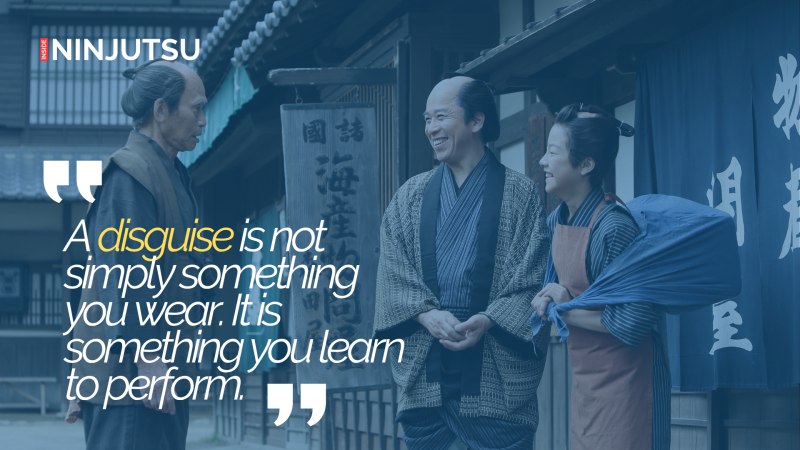
Disguise is one of the most intriguing areas of shinobi training, but effective disguise involves far more than changing clothes. Historical accounts and traditions point towards the ability to alter appearance, speech, posture, movement and behaviour in order to present an appropriate identity.
For the modern student, acting can therefore be an unexpectedly useful form of training. Learning to adopt a character teaches awareness of voice, posture, accent and movement, while also encouraging you to think about how different people behave and communicate.
A convincing disguise is ultimately about understanding what makes someone appear to belong in a particular environment.
BECOME AN ACTIVE STUDENT
The serious study of the shinobi arts requires more than owning a collection of books. Read actively. Take notes. Compare sources. Draw diagrams. Record questions. Test ideas where it is safe to do so.
A notebook filled with observations can be one of the most useful pieces of equipment a modern student owns. The aim is not simply to collect information, but to organise it and return to it. Ask who wrote a source, when it was written and why. Compare it with other evidence. Accept that sometimes there may be no definite answer.
Most importantly, do not allow your training to stagnate. Repetition is essential for developing skill, but repeating the same routine year after year without learning anything new eventually becomes a loop.
Add something to your training every year. Learn Japanese. Study navigation. Visit battlefields and castles. Research psychology. Explore traditional Japanese culture. Take an acting class. Develop a new practical skill.
The historical shinobi is often imagined as a mysterious figure hidden in the shadows. But perhaps the greatest lesson for the modern student is much less mysterious.
The world itself is the training ground.
The serious student of the shinobi arts should train the body, but also train the eyes to observe, the mind to question and the curiosity to keep learning. The goal is not to look like a ninja.
It is to become the kind of person who never stops trying to understand the world around them.

1. Start a Shinobi Notebook
Record research, training ideas, diagrams, vocabulary and questions.
2. Learn Basic Japanese
Begin with hiragana and katakana, then gradually build useful vocabulary.
3. Expand Beyond Martial Arts
Combine physical training with research, navigation and practical skills.
4. Visit Historical Locations
Explore castles, battlefields, museums and traditional buildings.
5. Study Human Behaviour
Learn to recognise patterns in how people communicate and interact.
6. Learn to Read Maps
Develop navigation skills and understand how terrain influences movement.
7. Try an Acting Class
Explore posture, voice, movement and character.
8. Study the Weather
Observe how rain, wind, darkness and the seasons affect movement.
9. Test Historical Ideas Safely
Use controlled and lawful experimentation to better understand historical methods.
10. Learn Something New Every Year
Keep your training evolving by adding a new skill or area of knowledge.

MORE CONTENT


Add comment
Comments