

Cutting Through the Myths
PUBLISHED 1 MAR 2026
Nine Directions Tests the Ninja Infiltration Kit
Ninja were not shadowy assassins in black pyjamas. They were professional intelligence agents operating in Japan’s medieval period—gathering information, sowing confusion and penetrating spaces designed to keep intruders out. Stealth required planning. Planning required tools.
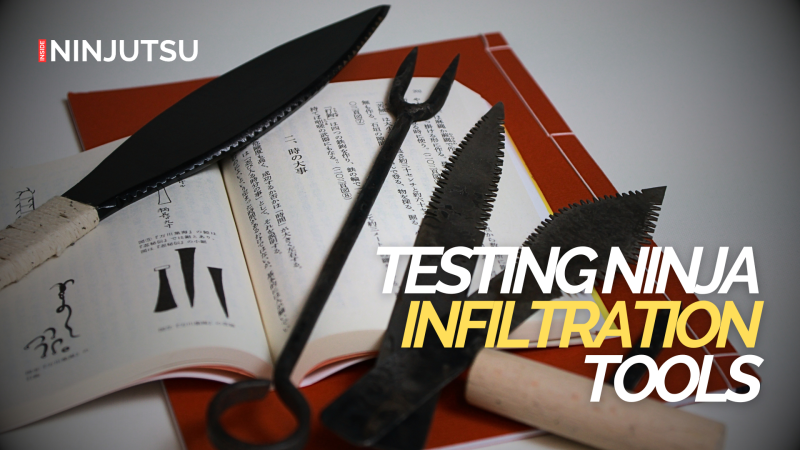
A recent living history experiment by the Nine Directions YouTube channel set out to answer a simple question: did the shinobi infiltration kit really work?
The man behind the test is a Canadian blacksmith and practising ninjutsu student who decided to reproduce the tools described in classical sources and put them to practical use. Drawing on architectural references such as Measure and Construction of the Japanese Home by Heino Engel, Japanese Homes and Their Surroundings by Edward S. Morse, and Japan Country Living by Amy Sylvester Katoh, he constructed scaled-down test walls inspired by Sengoku-era buildings.
Then he began cutting.
The Ninja Kai-ki: A Toolkit for Espionage
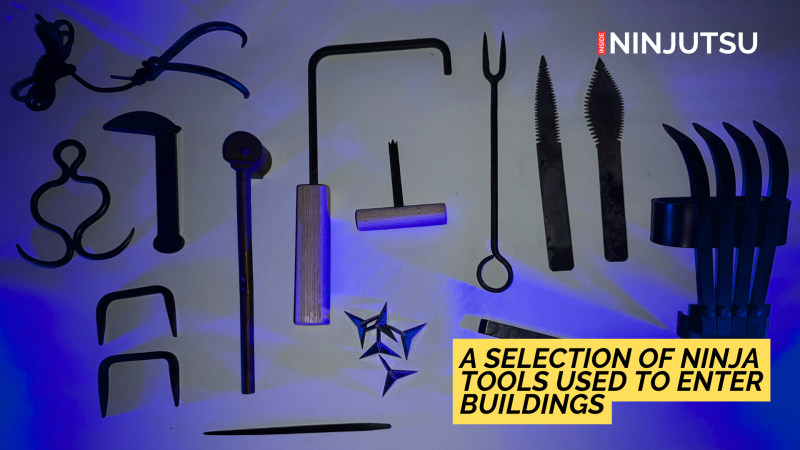
Inside what is sometimes referred to as the ninja kai-ki—the tools of infiltration—you’ll find a compact but versatile set:
- Noko giri – a heavy-bladed saw
- Shikoro giri – a thin-bladed saw for tight spaces
- Kiri – a hand drill
- Tsubo giri – large and small boring drills
- Kagi nawa – hook and rope
- Kunai – the iconic multi-purpose iron tool
Though not always included in surviving kits, two additional items were essential for sabotage: kasugai (steel staples) and small bamboo nails.
“This little kit was what allowed them to get into all of those wonderful places,” the experimenter explains. “Shinobi understood that knowledge is power—and that meant mastering entry.”
Each tool had a primary function in carpentry or construction. In the hands of a ninja, those functions were adapted for infiltration.
The Tsubo giri drills were designed for boring precise holes in timber. The Kiri hand drill could prepare pilot holes or secure doors and gates—either to keep enemies out or lock them in. The Shikoro giri saws, with modified tips lacking modern safety stoppers, allowed cuts to begin in the middle of a surface rather than from an exposed edge. The Kagi nawa provided vertical access and control, doubling as a binding implement. And the Kunai, far from being a throwing dagger fantasy, functioned primarily as a lever, pry bar and digging tool.
Compact. Adaptable. Purpose-built for wood.
Building Sengoku Defences
To test the tools properly, four wall types were constructed:
- Veranda plank wall – representing outer sliding wooden storm shutters.
- Shoji panel – light wood frame with paper backing for interior rooms.
- Solid timber wall – ¾ inch thick board to test raw boring power.
- Model entrance door – complete with a heavy locking beam, similar to small tea-room doors.
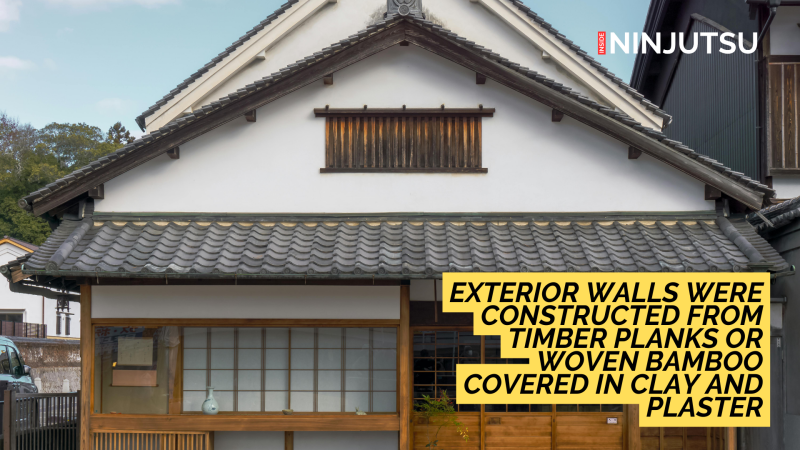
Each structure reflected typical Sengoku-period construction, where wooden channels, sliding tracks and locking beams formed layered defences.
The objective was not brute-force demolition. It was infiltration—entry with minimal damage, minimal noise and, ideally, the ability to restore everything to its original appearance.
Cutting, Leveraging and Listening
The veranda wall presented the first challenge. Sliding boards sat in channels, protected by internal stops. Simply lifting them out was not an option.
The solution? Leverage.
Using the Tsubo giri not as a drill but as a pivot point, the experimenter created a subtle grip. Combined with careful prying from the Kunai, he was able to open a channel just large enough to remove a section of trim. The Shikoro giri then allowed a controlled cut precisely where needed.
Once access was achieved, the panel could be dismantled and replaced.
To conceal the breach, the Kiri hand drill created small holes for bamboo nails, while kasugai staples secured everything back into position. In darkness, the entry point would appear untouched.
“It sure would hold up in the dark,” he notes. “And that’s really all I’m looking for.”
The Surprise Performer: Tsubo Giri
The solid timber wall became the real test of the kit’s effectiveness.
Here, the Tsubo giri was used as intended—to bore a circular hole through ¾ inch thick wood. Working at full speed, without regard for noise discipline, the hole was completed in roughly ten minutes.
“I really thought this tool was going to be useless,” he admits. “I thought I would be here half an hour just to get halfway through. I was dead wrong.”
Unlike a saw, which pushes sawdust through to the far side, the boring drill removed material toward the operator, leaving less obvious external evidence. The resulting hole was clean and round, requiring minimal lateral movement—an advantage when working from a suspended position on a rope ladder attached to a Kagi nawa.
In some contexts, the drill proved superior to a saw.
Controlling Exit and Escape
The shoji panels and entrance door revealed another aspect of the ninja mindset: not just entry, but control.
By inserting kasugai staples discreetly into sliding channels, doors that once moved freely could be immobilised. In a crisis—fire, confusion, panic—seconds matter. A blocked exit could redirect occupants toward a chosen route or buy time for escape.
The experiment also explored methods of identifying and defeating locking beams behind doors. In many cases, brute cutting would be wasteful and noisy. Intelligence—knowing construction methods and weak points—was more valuable than force.
“Knowledge is power,” he repeats, echoing the historical shinobi ethos.
Combat Versatility
Though focused on infiltration, the experiment also highlighted the dual-purpose nature of the tools.
The Kunai functioned as a lever or blunt striker rather than a knife. The saws, when reversed, could become vicious ripping implements. The drills, with their hardened points, resembled stilettos capable of thrusting attacks.
This was not a kit of fantasy weapons. It was a modular system for woodwork, sabotage and survival.
What Survived?
All four walls were defeated in some fashion. None were immune.
The veranda could be dismantled quietly with preparation. The shoji could be opened incrementally to gather intelligence. The solid wall could be penetrated faster than expected. And the entrance door, while formidable, could be neutralised through subtle reinforcement or targeted knowledge of its structure.
The biggest revelation was not that the tools worked—but how intelligently they were designed.
The experimenter closes with a challenge to viewers: what other historical tools have we dismissed too quickly?
For practitioners of ninjutsu, the lesson is clear. The shinobi were not magicians. They were craftsmen of access—students of construction, physics and patience.
Sometimes, the most powerful weapon in the ninja arsenal wasn’t the blade. It was understanding.



Add comment
Comments